Friday, May 15, 2020

When you *don't* play the game of thrones...

...you win and you fly.
The GoT Finale—One Year Later.

By Michael Isenberg.

This week marks one year since the controversial series finale of Game of Thrones. It’s a good time to look back and ask whether the final episode, or for that matter, the final two seasons, were really as bad as everyone said.

The short answer: yes. The widespread criticisms were richly deserved—with one big exception.

For eight years, well, six, anyway, we were hooked. Not since the original Star Wars trilogy were we so immersed and united in a shared pop culture experience. We were thrilled by the triumphs of our favorite characters—and we all had our favorites. We shared their frustration in defeat. We laughed at their jokes. We mourned at their deaths—and there were too many of those; it’s been said that author George R. R. Martin was the greatest serial killer in history. We couldn’t believe it when Ned Stark wasn’t rescued from the executioner at the last minute. We admired Olenna Tyrell for facing death with resignation and defiance, the Queen of Thorns’ acid tongue not failing her, even as the poison went to work in her veins. She made a good end.

We delighted in the wonderful one-liners and catch phrases. Some were merely good writing. “I have a tender spot in my heart for cripples, bastards, and broken things.” Some were insightful. “Everything before the word 'but' is horses—t.” “When you play the game of thrones, you win or you die.” Many became part of our daily speech. “You know nothing, Jon Snow.” “Winter is coming.” “Hodor.”

In between seasons, we theorized endlessly. Whatever happened to Rickon Stark? What about Gendry? How will Jon Snow be brought back from the dead, and will it have something to do with the Red Lady showing up at Castle Black? Who are Jon’s real parents? Will he and Dany end up together? And most important of all: who will sit on the Iron Throne in the end?

We nagged our friends who weren’t into it to give it a try for just one episode. And then, when they finally relented, we fretted during the slow and confusing opening scene—surely we were going to lose them. We needn’t have worried. The moment they saw Bran Stark shoved from the tower window, they were as stunned and horrified as we were the first time…and hooked for the duration.

And so it went for six seasons.

Then came Season 7. The source material of the published novels had been exhausted. As George R. R. Martin struggled to finish the next installment (he’s still struggling), the writers of the series ran on ahead. It was an okay season. We had the warm glow of the reunion of the surviving Stark children—not really children anymore after so many long years of separation, adventure, and character arc. And there was the “oh, s—t” moment when the White Walkers started dragging chains into the lake where a dead dragon lay at the bottom, and it became clear what they were going to do.

But something was off. Characters acted out of character. The honorable Brienne of Tarth, for whom the code of chivalry—the code of battle, honor, and loyalty—was everything, turned her back on that for a throwaway joke, “Oh, f—k loyalty.” The brilliant Tyrion “I drink and I know things” Lannister, advisor to kings and queens, was suddenly not so brilliant as his advice repeatedly proved disastrous. And the writers seemed to have lost sight of the geography of the Land of Westeros. Where once a character might spend an entire season traveling from one part of the country to another, now entire armies crossed the land as easily as if they were just popping over to the neighboring castle for a quick siege and some looting.

The downward spiral accelerated in Season 8. Armies practically teleported, and miraculously repopulated their ranks after being decimated in battle. The trickle of out of character incidents became a flood. Arya goes off to discover America for absolutely no reason. The cunning spymaster Varys, so often compared to a spider lying in wait, attempts a coup against Daenerys that is so clumsy, it's hard to believe this is the same guy who knew absolutely everything going on in Westeros and beyond, and patiently waited decades for revenge on the man who castrated him. Jaime Lannister, who tried to murder a child in the series premiere to cover up his incestuous and toxic love for his sister Cersei, was inspired by the noble Brienne to embark on an eight-year journey of redemption. He was taken prisoner, lost a hand, and mourned the deaths of every one of his children. And just when he finally reached the pinnacle of love and honor, he was like, “Sorry. Changed my mind. I’m going back to Cersei.” A painstakingly well-developed character arc wiped out in an instant.

And speaking of character arcs, there’s the dragon in the room: Daenerys Targaryan. She came a long way from the mousy teenage girl who submitted to an arranged marriage in order to further the ambitions of her brother, a brother who routinely quashed any attempt she made to assert herself by threatening to unleash his temper. “You don't want to wake the dragon, do you?”

From those inauspicious beginnings, she pulled herself up by her bootstraps, overcame every obstacle, and transformed herself into a ruler and a liberator. Her whole story is captured in her string of titles: “Daenerys of the House Targaryen, the First of Her Name, The Unburnt, Queen of the Andals, the Rhoynar, and the First Men, Queen of Meereen, Khaleesi of the Great Grass Sea, Protector of the Realm, Lady Regent of the Seven Kingdoms, Breaker of Chains, and Mother of Dragons.” She was so beloved, and her story so captured our imaginations, that hundreds of parents in the United States named their daughters Daenerys and Khaleesi.

A choice which they regretted when, with one episode to go, Daenerys turned irredeemably evil. Using the firepower of her dragon, she set King’s Landing aflame—after the city had already surrendered to her. Thousands died a horrific and painful death. Burning is a bad way to go. For Daenerys, there was no coming back.

Viewers hated it.

And this is where I part company with most viewers. I thought it was a brilliant arc for the character, one that was well-developed over the course of the series. We knew from the beginning that insanity ran in Daenerys’s family. Her father, the “Mad King,” was assassinated when he was on the verge of incinerating King’s Landing himself. There were signs of Dani’s ruthlessness as early as Season 3, when she bought the slave army, the Unsullied, from the “Good Master” Kraznyz. The price she agreed to in exchange was Drogon, one of her dragons. The transaction complete and the Unsullied under her command, she reneged on the bargain and ordered Drogon to burn Kraznys alive. Kraznys was an evil man, a slave trader after all, and couldn’t control Drogon anyway, which is perhaps why we didn’t notice the evil that was growing inside Dani. But evil it was and by Season 7 it couldn’t be ignored. “Bend the knee” became her new catchphrase as she demanded submission from everyone she encountered. Season 8 brought her slow burn over Jon’s growing popularity; she couldn't stand it that he was better liked than she was. Unlike Jaime Lannister, Daenerys didn’t subvert her character arc in the final episodes. She fulfilled it.

Not only is it a well-crafted storyline, it’s profoundly philosophical. As Lord Acton warned us, “Power corrupts. Absolute power corrupts absolutely.” Dani was a sweet girl at first, and when she first tasted power, she used it for good—she postponed her own ambition of taking the Iron Throne in order to liberate slaves across the Narrow Sea. But as her armies swelled, and her enemies fell before the might of her dragons, the power went to her head. As it inevitably will when even those with the best of motives—which she had—are able to act with impunity. It’s a valuable lesson. To those of you who say that it's only a TV show, that the burning of King's Landing was a fictional atrocity, I remind you that recent history is littered with real ones: the Armenian Genocide, the Nazi Holocaust, the Gulags of Soviet Russia and Red China, the ISIS Caliphate, to name but a few. A hundred million people and then some were murdered by dictatorships of one form or another. Not in some distant, less enlightened past, but as recently as the lifetimes of our grandparents, if not our own. If we learn anything from Game of Thrones, it should be to keep a close eye on our public servants and stand up against any effort on their parts to accumulate power. Eternal vigilance is the price of liberty.

In the end, with Daenerys dead and the Iron Throne melted, the nobles of Westeros were wise to make Bran Stark their new king. Not for the reason that Tyrion gave, “There’s nothing in the world more powerful than a good story…Who has a better story than Bran the Broken?” That was pathetic. It reminded me of the bookmobile guy from South Park. “Hello kids! I see you’re discovering the maaaaaagic of reeeeeeading.” Rather, Bran is the best choice because he has no interest in power. There’s something to be said for a king who tells his Small Council to “carry on” and leaves to incarnate the three-eye raven.

When you don't play the game of thrones, you win and you fly.

Michael Isenberg drinks bourbon and writes novels. His latest book, The Thread of Reason, is a murder mystery that takes place in Baghdad in the year 1092, and tells the story of the conflict between science and shari’ah in medieval Islam. It is available on Amazon.com

Please follow Mike on Facebook and Twitter.

Subscribe to Nerds who Read.

Photo credit(s): nme.com

Friday, May 8, 2020

Dreams of the Purple Buffalo

The Neverending Story by Michael Ende.
Book Review by Michael Isenberg.

Every once in a while at Nerds who Read, we like to revisit one of the classics.

The Neverending Story was written by German author Michael Ende and initially published in Germany in 1979, where it became an instant bestseller. Its audience expanded worldwide thanks to the 1984 film starring Barret Oliver and Noah Hathaway. To use a phrase which I think came from Cinema Sins, the theme song is so aggressively ‘80s it’ll make you spit out your Tab. And while the special effects seem cheesy and dated in this CGI age, they were groundbreaking at the time.

I loved it.

1980s me couldn’t get enough. Went out to Waldenbooks at the mall and bought a special edition of the novel; I think it had extra pages with glossy stills from the movie (I wonder what ever happened to it). But upon reading it, I had decidedly mixed feelings. It was one of those rare cases where the movie was better than the book. That was because the movie kept what was good about the book, and left what was not so good behind.

On the opening page, we meet Bastian Balthazar Bux (three B’s), “a fat little boy of ten or twelve. His wet, dark-brown hair hung down over his face, his coat was soaked and dripping.” We learn he is neither athletic, nor bright, nor popular. On the run from bullies, Bastian takes refuge in a used bookstore where he encounters the crusty old proprietor, Carl Conrad Coreander (three C’s). But it’s the book that Coreander is reading that has Bastian mesmerized. “It seemed to have a kind of magnetic power that attracted him irresistibly…It was bound in copper-colored silk that shimmered when he moved it about…in strangely intricate letters, he saw the title: The Neverending Story.”

Yes, like The Tennessee Waltz, or a drawing by M. C. Escher, The Neverending Story is a work of art which contains itself. Which probably accounts for the double uroborus device on the spine—two snakes, intertwined, biting each other’s tails.

Anyway, the one thing Bastian loves is books and, thrilled by the prospect of one that never ends, he steals it when Mr. Coreander steps away to take a phone call (or in the case of the movie, borrows it without permission). Blowing off classes, Bastian locks himself in the school attic, stretches out on a pile of old gym mats, and begins to read.

He reads that the Land of Fantastica (Fantasia in the movie) is in danger. Piece by piece, it’s being devoured by—nothing. A conversation between Blubb, the will-o’-the-wisp and Gluckuk the rock chewer explains:

“Something has happened in Moldymoor,” said the will-o’-the wisp haltingly, “something impossible to understand. Actually, it’s still happening. It’s hard to describe—the way it began was—well, in the east of our country there’s a lake—that is there was a lake—Lake Foamingbroth we called it. Well, the way it began was like this. One day Lake Foamingbroth wasn’t there anymore. It was gone. See?”

“You mean it dried up?” Gluckuk inquired.

“No,” said the will-o’-the-wisp. “Then there’d be a dried up lake. But there isn’t. Where the lake used to be there’s nothing—absolutely nothing. Now do you see?”

“A hole?” the rock chewer grunted.

“No, not a hole,” said the will-o’-the-wisp despairingly. “A hole, after all, is something. This is nothing at all.”

We later learn that the pieces of Fantastica that are swallowed by the nothing reemerge in our own universe—as lies.

But the people of Fantastica know nothing of that. They send petitioners from all over the land to the Ivory Tower to warn the Childlike Empress of similar occurrences, and beseech her for help. It turns out that the Childlike Empress herself is suffering from a mysterious illness, somehow linked to the destruction of Fantastica. Still, she takes action. She orders that a hero, a savior, be sent on a quest to save the land: Atreyu, who lives in the Grassy Ocean beyond the Silver Mountains and hunts the purple buffalo. Her emissaries travel to the Grassy Ocean and find him. And to their amazement, he is a ten-year-old boy.

Then the adventure begins in earnest.

This movie follows the first half of the book very closely, and I love this part of the book for the same reason I loved the movie: Atreyu’s heroism. He even looks like a hero:

His long trousers and shoes were of soft buffalo leather. His body was bare from the waist up, but a long purple-red cloak, evidently woven from buffalo hair, hung from his shoulders. His long blue-black hair was gathered together and held with leather thongs. A few simple white designs were painted on the olive-green skin of his cheeks and forehead.
But it’s not his looks, or even his skill with a bow that make Atreyu heroic. It’s his persistence, that he keeps going despite cold, despite hardship, despite nightmares. Each night he dreams that “he got closer and closer to the same purple buffalo—he recognized him by a white spot on his horsehead—but for some reason he was never able to shoot the deadly arrow.” He even goes on despite loss. Early in the quest, in the Swamps of Sadness, his beloved horse Atrax succumbs to hopelessness and sinks into the muck, meeting his death. But Atreyu masters his sorrow and plods on.

Of course we see Atreyu as a hero because we see him through Bastian’s eyes, and Bastian sees him as a hero. As Atreyu overcomes one obstacle after another, Bastian’s admiration and compassion for him draws him ever more deeply into the story, until he is literally transported into the Land of Fantastica. Which, it turns out, was Atreyu's real mission all along.

The 1984 movie pretty much ends at this point. A brief montage shows us that Bastian has a whole series of fantasy adventures of his own in Fantasia, and then the credits roll. These adventures constitute the second half of the book, the part I didn’t like as much. Some of them found their way to the big screen in The Neverending Story II: The Next Chapter (1990), which was such a critical and box office flop that, despite being a fan of the original, I didn’t even know it existed until I started putting this review together. As for The Neverending Story III: Bastian goes to High School (that’s not what it’s really called), the less said the better.

Atreyu is still around in the second half, and he and Bastian become friends. But it’s really Bastian’s story now.

Much like Butters in the “Imaginationland” episodes of South Park (which were no doubt partly inspired by The Neverending Story), Bastian is human, and unlike the natives of Fantastica has the power of imagination: whatever he wishes, comes to pass.

This power proves extremely useful, as—once again similar to Imaginationland—much of Fantastica needs to be reconstituted out of the devastation left by the nothing. Indeed, Bastian’s imagination is quite fertile, and the Fantastica of the second part of the book is far more…fantastic. There’s a forest of gigantic night-blooming flowers in phosphorescent colors, which crumble into sand dunes under the heat of the sun, each one a different color. “The nearest was cobalt blue, another was saffron yellow, then came crimson red, then indigo, apple green, sky blue, orange, peach, mauve…” The list goes on for some time. The Desert of Colors. Then the sun sets and the night forest grows again.

But things take a dark turn as Bastian uses his power on himself: to make himself handsome, strong, brilliant, athletic, adored. All the things that he’s not in the real world.

That power comes with a price. Each time he wishes for something, he forgets a little bit of his real life. He forgets who he is. He becomes greedy for power. He creates enemies for himself to defeat, such as the evil witch Xayide. But unlike the obstacles that Atreyu faced in the first half of the book, there is no challenge for Bastian. The power of his wish predictably carries the day every time. He drifts apart from Atreyu as he puts his confidence in Xayide, who unlike Atreyu, doesn’t have his best interests at heart. She convinces him that Atreyu is conspiring against him, setting up a final conflict between the two. In short, Bastian becomes a dick.

Lies are nothing. Imagination is forgetting. It seems to me that, in addition to creating a spectacular fantasy world that is home to some memorable characters and exciting adventures, Michael Ende was trying to say something profound. But I’ll be damned if I can figure out what. Like Atreyu’s dream of the purple buffalo, I keep getting closer and closer, but never seem to be able to hit the target. If you got an idea, please leave a comment.

Michael Isenberg drinks bourbon and writes novels. His latest book, The Thread of Reason, is a murder mystery that takes place in Baghdad in the year 1092, and tells the story of the conflict between science and shari’ah in medieval Islam. It is available on Amazon.com

Please follow Mike on Facebook and Twitter.

Subscribe to Nerds who Read.

Friday, May 1, 2020

The Same S—t All Over Again

Jay and Silent Bob Reboot.
Movie Review by Michael Isenberg.

"Well, a reboot, boys, is when Hollywood wants to make a lot of money without the hassle of creating a new movie. So they take an old movie and change just enough to make you pay for the same s—t all over again…Oh, it’s insidious. They take a flick you loved as a kid and add 'youth' and 'diversity' to it."

That's the exposition dump we get near the beginning of Jay and Silent Bob Reboot (2019) and that’s exactly what the movie delivers. It takes 2001’s Jay and Silent Bob Strike Back, adds a dose of youth and diversity, and changes it just enough to make us pay for the same s—t all over again.

And it’s a riot.

As in the 2001 original, the duo of Jay (Jason Mewes) and his "hetero life mate" Silent Bob (Kevin Smith)—Jersey boys, stoners extraordinaire, and inspiration for the Bluntman and Chronic comic book—are pissed. They've learned that there are plans for a Bluntman and Chronic movie again and they're determined to put a stop to it again. And so they set off on a wacky cross country journey—Destination: Hollywood. AGAIN.

Along the way they cross paths with numerous celebrities making cameo appearances, as well as four young women who aren’t what they seem. But here are the important differences: In Jay and Silent Bob Strike Back the four young women are all white. In Jay and Silent Bob Reboot they are each a different ethnicity—and one is also differently-abled. And although the actresses involved are in the same general age range in both movies, the 2019 quartet don't have quite as ambitious a scheme in the works as their 2001 counterparts. The four women in Strikes Back are plotting to rob a high tech diamond warehouse. The four women in Reboot are plotting to go to Comic Con—which makes them seem more youthful. But perhaps most significant of all, in this era of #MeToo, only one of them is wearing a leather catsuit under her clothes.

You've probably grasped by now that, as with Strike Back, the basis for the humor in Reboot is self-reference. The film is chock full of pop culture references in general and Kevin Smith references in particular. For the ultimate in self-reference, in addition to reprising his role as Silent Bob, Smith also plays himself as the director of the Bluntman and Chronic reboot, prompting one of the four women to comment “I hate this guy. He forces his kid to be in everything he makes.” The self-referential joke is that she is played by Smith's IRL kid, Harley Quinn Smith.

Of course, there are differences between the two movies beyond diversity and youth. Nearly twenty years have passed since Strike Back, which means nearly twenty more years of cultural phenomena to make fun of. Comic Cons, Uber, white nationalism, emojis, Marvel movies, Cop Out, No Fly Lists, the Bechdel Test, and Russian plots to steal elections are all grist for the satire mill.

Also in contrast to the original, Reboot has a serious side. Since 2001, Kevin Smith has lost a father and raised a child. He has channeled his reflections on these experiences into Jay and Silent Bob Reboot via a heartwarming subplot in which Jay discovers he has a long lost daughter, for whom growing up without a dad has left an awful hole. Ben Affleck, reprising his Chasing Amy role as Holden McNeil, sums it up: “I used to think life was all about me. I was the hero of my own story, a Bruce Wayne of one lifelong issue of Detective Comics, so to speak. And then that kid came along and suddenly you realize you're not Bruce Wayne anymore. You're Thomas Wayne.”

Even when being serious, Reboot can’t avoid self-referential humor. Affleck’s next joke is the funniest in the movie. But in the interest of avoiding spoilers, I won’t quote it for you. You'll just have to watch the thing.

Which I recommend you do. You can catch it streaming on Amazon Prime. Watch the 2001 original first (or re-watch it as the case may be) to be sure you catch all the references. If it’s not enough that Jay and Silent Bob Reboot is wickedly funny and actually has some things to say, it does have one more thing going for it: stay through the end credits to see what may very well be the absolutely last Stan Lee cameo ever.

Michael Isenberg drinks bourbon and writes novels. His pop culture satire, Full Asylum, pokes fun at corporate life, James Bond films, political correctness in Hollywood, and professional wrestling. It's available on Amazon.com

Please follow Mike on Facebook and Twitter.

Subscribe to Nerds who Read.

Photo credit(s): Lionsgate, YouTube, Augusta Chronicle

Friday, April 24, 2020

Full Steam Ahead!

RPG Books Part 3.
By Kerey McKenna.

After deciding to use my “shelter in place” time to dust off my RPG books and amuse myself and some friends with a game of Space 1889, it was now time to meet via web conference and play the game.

What follows is the story that my players and I created over the course of a few hours, weaving together my general plot, the random chance of dice rolls, and some improvisational acting all around. As I mentioned in Part 2 of this series, I do not want to get into the weeds of describing the rules and system of the game, and I must admit I was so nervous about running this new game I did not think to record the video conference or note the specific numbers on the decisive dice rolls, just their success or failure and the effect they had on our shared narrative.

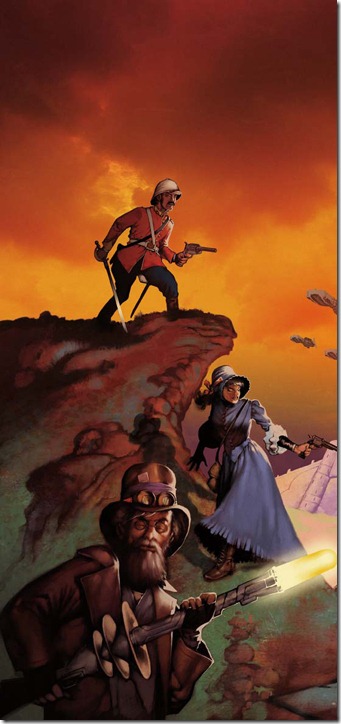
Our story began with Hazel the Gunslinger Gadgeteer and Reginald, wayward aristocrat raised by fierce giant birds, on a steamship entering San Francisco harbor. In addition to the sea and rail traffic of the bustling port city, dirigibles land and depart from an aerodrome adjacent to the bay. Although this would be Reginald’s first time on American soil, his reputation preceded him as he had made quite an impression at a high society party in the Kingdom of Hawaii. With some epic “Pygmalion” style tutoring from Hazel, the long lost aristocrat was re-introduced to the world. While his manners were still a bit odd, it turned out that there is some compatibility between wild bird law and Victorian etiquette: chiefly defer to the elders with the most plumage on their heads, females are impressed by dancing ability, and puff up your chest and stand your ground if another male acts aggressively towards you. Despite, or perhaps because, he knocked out a wealthy planter’s son with a swift kick to the head during a duel, Reginald had become quite the cause celebre. So much so that The San Francisco Examiner had offered to fund Reginald’s expedition to Mars in exchange for exclusive rights to the story.

Meeting the press team from the Examiner almost ended with disaster when the blinding flash from a staff photographer confused Reginald coming down the gangplank and in a panic he bowled over the reporter. Next he almost started a fight with the staff photographer, who turned out to be Fritz, a Venusian lizard-man recently immigrated from the Kaiser’s offworld colonies. Fortunately Hazel was able to de-escalate the situation and begin proper introductions between Reginald and the attractive girl reporter that he had bull-rushed. Her name was Patricia, and her “Uncle Willy” had gotten her a job as a society reporter at the family paper, but she was hoping to become a stunt girl reporter like her heroine Nellie Bly. Because I was playing the character she probably sounded like someone doing a very bad Katherine Hepburn impression.

With introductions properly made and Reginald talked down from a lamp post that he had perched himself upon, the party made their way to a private steam-driven coach. After some small talk, they were surprised to find that the carriage was steaming past the offices of the Examiner, the carriage doors were locked from the outside, and they lost consciousness as the interior was pumped full of knockout gas.

When they finally wake up, they find themselves aboard a stately lounge car on the “DM RAILROAD,” a villainous monologue coming over the speaking tube. The monologue was courtesy of robber baron Damien Montebank. He explained that Hazel, Reginald, and Patrica had all wronged him. Hazel had been excessively curious about Montebank's mining operations. Patricia had written an unflattering article about the coming out party for Montebank's niece, not even sparing the poor girl's dress design which, in all fairness, was rather bizarre. Reginald had the unmitigated gall to be the son of the woman who Montebank had desired, but had been too shy to talk to. She had therefore married Reginald's father, a man who had actually courted her. As for poor Fritz, the NPC camera-lizard, he was just collateral damage.

Montebank informed our heroes that they were on his private train speeding through the California wilderness. To escape with their lives they would have to go from car to car clearing the challenges and traps he had set for them along the way. Barbed wire had been placed along the roof to prevent them from skipping any cars, and the car couplings had been thoroughly locked so they couldn’t simply uncouple their car to escape.

As I mentioned in Part 2, “railroading” refers to a design in video games and RPGs in which the players have little to no actual agency in the scenario. My players, both old hands at RPGs (David even hosts his own weekly game via web conference), immediately picked up on the idea that this was a rather literal spoof of a railroading scenario and went about doing what RPG players do best...DERAILING the carefully laid plans of the game master. They destroyed Montebank’s speaking tube before he was done with his villainous monologue.

After discovering that some of the bottles of liquor in the lounge car were poison, they proceeded to the next car, the bar car. There Montebank presented them with an old logic puzzle: Three jugs sit on the bar. One, which holds eight cups of water, is full. The two empty jugs beside it have capacities of three cups and five cups respectively. The players are instructed to put a jug holding exactly four cups of water on a scale. If they have the correct amount, the electronic lock on the door to the next car will open. If incorrect, whether by too much or too little, the scale would set off a bomb. You know, like in Die Hard 3.

Before presenting the puzzle to the players, I had been sure to study the mathematical process for solving the jug problem and even had a computer program they could use to simulate pouring the water from jug to jug ready to go.

However Hazel (Melissa) cut right through the Gordian knot by using her mechanical skills to deftly remove the bomb from the scale and re-purposing the explosives to just blow up the electric lock. Then, before proceeding to the next car, Reginald (Dave) was sure to also destroy the speaking tube in this car.

Moving on to the next car, this time a simple box car, they found their path blocked by two large guard dogs. Instead of engaging the dogs in combat or trying to charm the beasts, Hazel went back to the first car, used the lethal liquor to poison some food which she then fed to the dogs. With the dogs quickly incapacitated, the players moved to the next car and were greeted by burly hired goons.

With a mechanical whir, Hazel’s prosthetic mechanical hand snapped open to reveal a revolver. Her first shot at the charging goons had enough stopping power to take one of them right out of the fight. Reginald rushed the bruisers, letting out a fierce bird war cry, which did nothing to unsettle them as they did not speak “Bird” and thus could not comprehend his threat to upend their nests and smash their eggs. Fortunately Reginald’s bird-based fighting style of powerful kicks and head butts was very effective in the melee. He was supported by Fritz the camera lizard, who though mild-mannered, acquitted himself quite well using his sharp claws. Hazel fired her “hand gun” again but this time the shot went wide, and sadly Patricia was of no use as the kidnapped heiress reporter was trying not to faint. Reginald, having dispatched his first opponent, was able to rush to Hazel’s defense and body slam the goon that was trying to charge her. Finally Hazel ended the combat by filling another goon full of lead and the last goon full of fear (because her threats were uttered in English and not Bird).

Making their way towards the engine they discovered their tormentor Damien Montebank trying to escape the train by launching a one man dirigible. Before the villain could leave the launch platform (presumably to shake his fist and promise to get them the next time), Hazel fired into the hot air envelope slowing his ascent. Reginald charged for the dirigible basket, again uttering a fierce bird war cry. The fierce cry shook Montebank to his core because even though he didn’t speak Bird the intent of the fit young man charging him with hate in his eyes was clear enough. Reginald leapt up to the dirigible basket, pulled the craven robber baron from the flying machine, threw him down to the launch platform and thrashed him to within an inch of his life.

The young reporter exclaimed that this would be a rousing story for the Examiner and that Montebank would be brought in to the authorities for daring to kidnap...Patricia Hearst.

So that was how I entertained my friends for an afternoon. As I said this is the story that we created. The actual playing of it involved a lot of improvisation and consultation with the rule book about what dice a player would have to roll to accomplish a certain stunt or attack. I doubt I would have even made any attempt to document our session if I had not been planning to write these articles. All things considered, I think it went well, and someday in the not too distant future we can all get together in person and have another game. My RPG books for this game alone contain the potential for years of stories set on a steampunk Earth, the dense jungles of Venus, or the red sands of Mars.

Hopefully our next game will be in person. Maybe we can wear steampunk costumes and I can serve Victorian-themed food and drink.

After, all the shelter in place orders will probably only last <checks notes> “1d20”* more days.

Kerey McKenna is a contributing reviewer to Nerds who Read and SMOF for the annual Watch City Steampunk Festival in Waltham, MA. Check it out at www.watchcityfestival.com.

Subscribe to Nerds who Read.

Photo Credit(s): YouTube

*-"1d20" is RPG-speak for "Roll one twenty-sided die."

Friday, April 17, 2020

Unburying the Hatchet

Amy Lynn: Rock Star by Jack July.
Book Review by Michael Isenberg.

When we last left Amy Lynn Braxton, at the end of Jack July’s Amy Lynn: Hatchet (2018), the CIA’s badass assassin was handing in her resignation. She made the decision while she was getting out a suitcase to lend to a friend. Her 2½ year old daughter Katherine misunderstands the situation and says, with a heartbreaking expression on her face,

“Momma?...Come home to us.”

Amy Lynn writes her resignation email on the spot. She lets Katherine click the send button. She literally buries the hatchet—the hatchet that not too long before she had planted in the skull of a Nigerian imam who was funding Boko Haram.

Amy Lynn: Rock Star, the sixth installment in the series, which launched on Amazon last week, finds our heroine questioning her retirement.

By any stretch of the imagination, she has a fairy tale life. Wife of a billionaire, Lady of an Irish castle, with the Duchess of Cambridge on speed dial, she nevertheless stays close to her roots in Black Oak, Alabama. There, in a house within sight of the one she grew up in, she has spent the last three years or so taking care of her brood, which in addition to Katherine is supplemented by a growing number of strays—homeless or abused children she has taken in. It’s a house with love in it. And chicken and biscuits. And Jesus.

And yet, it’s not enough.

Amy Lynn tries to fill the void by becoming assistant coach to the girls’ swim team at her old high school. But it goes badly (at least at first) as she pushes the girls too hard.

Amy’s story—the story of a powerful and independent woman in a world that often feels threatened by powerful and independent women—is mirrored by that of her friend and former colleague Tatiana. But their marriages are very different. While Amy’s husband makes it clear that he’d prefer she didn’t go back to the CIA, there is no doubt he will support whatever she decides, T’s husband isn’t nearly as understanding. When she comes back from a mission with ten staples in her scalp and two broken ribs, she’s dreading the inevitable confrontation. “I know what he’s going to say,” she tells Amy on the phone. “What about your family? Don’t you care about us?...I’m still a warrior, I love it—the thrill, the pain, the fear, surviving when I shouldn’t—you know, the game. When I hang up, I’m going to make a call, tell the truth and then, then, the person who is supposed to love me more than anyone in the world, is going to tell me I’m not a good person because I’m not who he thinks I should be.”

Rock Star is definitely a book about character development, both for Tatiana and for Amy. But there's still plenty of the hard-hitting action we’ve come to expect from the Amy Lynn series. Action in which those on the wrong side of Ms. Braxton come to painful and blood-soaked ends. And we love it because they totally deserve it. Screw political correctness. Screw lawyers. Screw the police. Well, maybe not the police. Provided they stay out of Amy's way.

Which brings me to the main plotline.

Sara Marcella Scruggs, aka “Cantrell California,” was the tween star of a popular children’s program on “The House of Mouse.” To paraphrase the disclaimer at the beginning of the book, any resemblance to an actual Disney tween star whose alias ends with the name of a western state is purely coincidental. Now grown up (almost), Cantrell is a selfish, coke-addled, and hugely successful rock singer.

After a private performance in Saudi Arabia, to celebrate the eighteenth birthday of two twin princes, the guests of honor, desperate to impress her, take her on a ride to Mecca—a place where no non-Muslim is permitted. It goes horribly wrong as Cantrell jumps from the car to take a selfie with her tits exposed—within sight of the Kaaba. Arrested, tortured, and raped for days in a Saudi prison, she is released and gotten out of the country thanks to the intervention of the CIA, a really big favor called in by Tatiana, and a heartstopping car chase to the airport.

But the Wahhabi establishment is outraged that the Saudi government allowed Cantrell to escape execution. They decide to take matters into their own hands by calling in one of the world’s most dangerous terrorists, Najm Udeen Barakat, a man with a tragic (and not wholly unsympathetic) past, who lives only to kill Americans. He is so elusive, western intelligence agencies don’t even know what he looks like. They know him only as the Ghost. “You have been chosen by the prophet,” the Grand Mufti tells him. “Go forth and avenge his name.”

There follows an international game of cat and mouse, as Cantrell sets out on a journey of redemption and Najm seeks to track her down and make her pay for her blasphemy. A game that inevitably puts him on a collision course with Amy Lynn Braxton. But is she still up to making the tough decisions that an agent has to make? It remains to be seen.

Amy Lynn: Rock Star is full of twists, mysteries, memorable characters, and suspense that had me turning the pages; I read the whole thing (almost 500 pages) in a day. If you're a longtime Amy Lynn fan, you'll definitely want to catch this installment. If you're new to the series, you should be able to start with Rock Star and follow what's going on. But if you prefer to start at the beginning, here's a review I wrote of 2012's original Amy Lynn.

In the interest of avoiding spoilers, I won’t tell you how things turn out, either for Najm’s mission, or for the various character arcs. But I don’t think it will spoil anything to say that this showed up on the author's Facebook feed the other day:

Can’t wait for Amy Lynn 7!

Michael Isenberg drinks bourbon and writes novels. His latest book, The Thread of Reason, is a murder mystery that takes place in Baghdad in the year 1092, and tells the story of the conflict between science and shari’ah in medieval Islam. It is available on Amazon.com

Please follow Mike on Facebook and Twitter.

Subscribe to Nerds who Read.

Photo credit(s): Amazon.com

Friday, April 10, 2020

RPG Books Part 2

The Adventure Begins.
By Kerey McKenna.

As I covered in Part 1, Role Playing Game (RPG) books contain a treasure trove of lore, inspiration, and game mechanics to weave elaborate games and stories for a small group of participants. Considering that spectating other people’s RPG sessions via podcast or vlog has recently become very popular, the stories created in these gaming sessions are entertaining increasingly larger groups of people. However that’s a bit beside the point since my goal was to entertain myself and a small group of friends via web conference while we all remain indoors. Games in which we remain indoors are going to be what we are all going to be playing for a while.

I decided to host a game of Space 1889, a steampunk adventure game in which the great Victorian nations sail the ether between planets in incredible steam-powered flying machines to encounter new life and new civilizations...then shoot the former and economically exploit the latter just like they did back on Earth. The game takes obvious inspiration from authors like Edgar Rice Burroughs, Julies Verne, H.G. Wells, and Sir Arthur Conan Doyle to create all-new adventures. The players assume the role of explorers and can even play as non-Earthling characters like Martians and Venusians.

I put out a call to other people who would be interested in playing and got responses from my two friends Melissa and David. Before the game session proper, we had a quick meeting via video conference to brainstorm a bit about what kind of adventurers their characters would be and how those strengths, weaknesses, and eccentricities would be expressed mechanically in the game system.

Melissa wanted to play a steampunk gadgeteer who had a bit of “Weird West” flavor to them. After spitballing some ideas, we came up with Hazel, a character that was exploring the world looking for the entrance to the “Hollow Earth,” a notion that reputable scientists in this world scoff at even though it would fit right in with their pulp-inspired universe. She is quite adept at both engineering and target shooting, so much so that when she lost a hand in an accident she incorporated a hidden revolver into the prosthesis. She also carries with her a bulletproof umbrella of her own design.

David seized upon the idea of making a character like Tarzan or Mowgli, a lost child raised in the jungle by animal guardians...but he wanted his feral foster parents to be sillier than apes or wolves. After kicking around some ideas around like Canadian beavers or Australian kangaroos, we decided that his character Reginald was an orphaned aristocrat raised by a flock of previously undiscovered extant giant terror birds. Brought back to civilization, the lost aristocrat becomes a popular curiosity among the upper crust and now he seeks to go to Mars to fly higher than either his human or his bird parents ever did.

Part of character creation was then giving numerical weight to the characters attributes. I don’t want to get too into the weeds on the mechanics of this but for those that are interested I used the Savage Worlds RPG system. To make a long story short, when a character wants to do something in the world, aim and fire a weapon, sneak past a guard, or learn the latest rumors going around the underworld, they roll dice to see if they succeed or not. These dice range from a four-sided die all the way up to a twelve-sided die. At character creation, the attributes that make a character, such as their intelligence or their skills like firearms, athletics, and diplomacy are assigned different kinds of dice. Low-sided for their weaknesses or skills they had little to no training in, and larger dice for skills and talents they are stronger in. Hazel the gadgeteer gunslinger had high intelligence and was skilled in abilities like marksmanship and engineering. Reginald the boy raised by giant birds had high number dice in skills like martial arts, athleticism, and intimidation but was unskilled in talents from the outside world like engineering or firearms.

The use of dice in RPGs (and especially dice other than six-sided dice) came about from a tradition of elaborate tabletop war games. Success or failure by roll of dice simulated the chaos of the battlefield: that sometimes strong battalions could fail or an underdog militia could have their day. To perform an action in this particular gaming system, say repairing a malfunctioning steam engine, characters are trying to roll a four or higher using their pertinent die. Hazel the mechanic with her eight-sided die in repair/engineering has a five out of eight chance of rolling that four or higher so the odds are in her favor. However she could roll a one to three, representing that the solution escapes her at this time, or she had dropped a tool and thus cannot fix the issue right now and must try again with a new roll on her next turn. Meanwhile Reginald, who knows nothing of machinery, would only be able to roll a lowly four-sided die with its paltry one in four chance of success. If he does roll that four, it appears that Reginald’s solution, giving the machine a good hard kick, brings the steam engine sputtering back to life by pure dumb luck.

While my players would be adventurers, I would be assuming the role of running the game as the Game Master or “GM.” Depending on what system or game you are using, the GM may be called anything from the Director, Storyteller, Umpire, or, in reference to Dungeons & Dragons, Dungeon Master (DM for short). That last one always sounded a bit too kinky for me to use personally but it’s pretty ubiquitous to the hobby at this point. The GM’s ultimate purpose mechanically is to present the players with a challenging scenario for them to have adventures in. Then, under this overarching goal, are various sub-duties and skills. The GM creates the starting point of the story or uses a story from the RPG book. The GM is then responsible for narrating what happens in the world, what the characters see, hear, smell, and touch, etc., and how their actions affect the world. The GM manages and interprets the game rules from the book and makes rulings on how the characters can get their desired outcomes. The GM also role plays other characters that the players interact with, friends, foes, monsters, random bystanders, shop keepers, etc. (These “non player characters” are referred to as NPCs). Finally the GM is making dice rolls on behalf of those NPCs as they interact with and even oppose the players.

For my game I had decided to run a short adventure of my own instead of a scenario directly from the game book. The premise was based on something I had half remembered from a chapter in a pulp adventure novel I read as a teen: the heroes would be trapped by a villain on a private train. The villain is playing their own version of The Deadliest Game, and each car of the train contains some obstacle or puzzle the heroes must overcome to get to the next car. I also set this up as a bit of meta humor because in gaming circles when a GM isn’t giving their players enough options or agency in the adventure they are said to be “railroading” the campaign. To further hang a lampshade on this I made the villain of the adventure, Dameian Mountebank, “DM” and gave him the characteristics and affectations of a bad micromanaging Dungeon Master crossed with Snidely Whiplash.

Of course if there is a danger of Game Masters railroading their players there is the opposite issue of players derailing or at the very least complicating the story by accident or design. For example, one of my players, David, was once the Dungeon Master in a game of Dungeons & Dragons in which I was a player. During part of the story, our characters were trekking through the wilderness and came upon an apparently abandoned small village. David had put that village there and if we had searched it our characters would have discovered clues that would be helpful later in the adventure. But I insisted that the party ignore the village and keep going to a larger settlement so we would be sure to get to the safety of high walls before nightfall and the rest of the players agreed. This then put David in the awkward position of either allowing us to continue, possibly without crucial information, or having to contrive other ways for us to discover it later. I have never lived this down.

But player improvisation, like the story beats created by the random dice rolls, is what makes this format of storytelling and gaming so unique. For example Dave and Melissa started changing my campaign, for the better, during character creation. I had originally envisioned my scenario as a simple introductory adventure that characters with no prior relationship to each other could be dropped into and then become a group. To maintain that surprise, during character creation I did not tell my players anything about the scenario their characters would be facing. As Melissa, Dave, and I brainstormed their characters, completely unprompted, the others started coming up with reasons why a gunslinger gadgeteer would be hanging around a feral aristocrat fostered by giant birds. Together, on the fly, they came up with a sort of prologue where Hazel had gone on an expedition to Reginald’s jungle island, reasoning that reports of wildlife thought extinct would lead her to the Hollow Earth where they would presumably have taken shelter from the great extinction eons ago. Reginald, impressed by Hazel’s ability to bring down large game with her firearms, agreed to reclaim his human family name and return to civilization. Now Hazel serves as a minder to Reginald as he re-integrates into human society and hopes that his notoriety will help fund further expeditions to prove that Earth and Mars contain vast underground habitats capable of sustaining humanoid life.

Now with the heroes created, we agreed to meet via webconference the following week to play through my scenario. And just how did the heroes fair against this dastardly murder train? Did my skills as a Game Master meet the satisfaction of veteran RPG hobbyists? What happens when man raised by birds encounters flash photography for the first time? For those answers and more, stay tuned to Nerds Who Read, for the final installment.

Kerey McKenna is a contributing reviewer to Nerds who Read and SMOF for the annual Watch City Steampunk Festival in Waltham, MA. Check it out at www.watchcityfestival.com.

Subscribe to Nerds who Read.

Photo Source(s): Stargazer’s World

Friday, April 3, 2020

Books, Pen, Paper, and Dice

Part One: Tomes of Lore.
By Kerey McKenna.

Like pretty much...EVERYONE these days I have been cooped up in my own house for extended periods of time. Now in this catastrophe that we all find ourselves in, it’s natural for bibliophiles and nerds to cozy up with their reading lists and media streams to wait the whole thing out. Now that we have all this time with our media, good thing we all got our reading glasses before everything shut down right?

While perusing my shelves trying to decide whether to pick up something from my “to read list” or to seek the comfort of an old favorite, I noticed a small subset of my collection that had been gathering dust...my RPG books. Here at Nerds Who Read we’ve looked at prose books, comic books, and TV and movies based on said books, but so far we've never come upon a reason to discuss that nerdiest of nerd books, the RPG book.

We get a lot of different kinds of nerds here at Nerds Who Read and I assume some of you are very familiar with RPGs, so most of this first article will be things you already know. Others may not have played but will recognize the general concept and the most famous RPG game, Dungeons & Dragons, from shows like Stranger Things. Perhaps for some readers, their only familiarity with the genre came from the “satanic panic,” when some moral guardian objected to the occult themes and use of dice in such games. Because dice, lead to vice, and the RPG, that rhymes with T, that stands for Trouble. RIGHT HERE IN RIVER CITY.

Paper Pencil RPGS as we know them today are a unique confluence of improvisational theater, board games (specifically tabletop war games going back to the late 1700s), and genre fiction (usually but not always some flavor of fantasy, science fiction, horror, etc). RPG stands for Role Playing Game because the players adopt the role of characters in a story. In board games like Monopoly, Clue, or Settlers of Katan, players are never not themselves and the actions they take on the game board are always towards the goal of winning. Even in a game like Clue where the game’s cover art (and the hilarious movie adaptation) suggest that every color of token should be a different eccentric character, participants don’t play act as Miss Scarlet or Professor Plum through a game framed as a manor murder mystery. Actually if anyone wants to host a murder mystery night game of Clue (after we’re released from social distancing) and we all dress in character please let me know if I can come and play too.

To me, RPG books are amazing artifacts in and of themselves. During my first foray into RPGs as a teenager, the clerk of a hobby store once told me that they believed the majority of customers bought more RPG books then they ever actually expected to use to play the games as intended. Over the years I’ve acquired books with no clear guarantee that I would ever get to play the game the book is a part of. And yet I will from time to time enjoy picking them back up to read. The vast majority of RPGS have a “Core Book” that may come in at several hundred pages because of all the things it has to do for the game. It serves as an instruction manual explaining how the mechanics of the game work. Furthermore because those rules can be so complex, many games include bestiaries of creatures, catalogs of items, and atlases of places real or fictional that are part of the RPG’s story. It can contain a work of short fiction or perhaps even an anthology of short stories that serve to illustrate the themes, lore, and game mechanics. And speaking of illustrations, depending on when the book was published and how much funding was put into it, there will be illustrations ranging from amateur art reminiscent of self-published fanzines to lushly painted illustrations created by professional graphic artists. Furthermore, many games will have supplemental books with additional, optional content like different stories, characters, game mechanics, settings and new approaches to playing the game.

The bit about this hobby that may surprise readers who only know RPGs by association with its most famous game, Dungeons & Dragons is that there are many, many RPGs that are not about stereotypical medieval high fantasy quests inspired by J.R.R. Tolkien with elves and dwarves casting magic spells. I have one game called Starfinder which takes some of the aspects of high fantasy but adds a science fiction space opera twist. I have another game called Shadow Run which is a mashup of high fantasy and the cyberpunk. Most of my collection dates back to when I was a teenager playing games set in the “World of Darkness.” This line of books are set in a world that was superficially like our own but just under the surface all manner of supernatural creatures like werewolves, vampires, and fairies are in hiding and the players assume the role of those creatures. I have another game, Mutants & Masterminds that is an all-out pastiche of comic book superheroes.

Inevitably, while revisiting my collection, I started pouring over my Space 1889 books. Space 1889 is very much a steampunk game; it takes a lot of inspiration from Jules Verne, H.G. Wells, and Edgar Rice Burroughs, imagining a world in which Victorians used fantastical machines to travel around the solar system, encountering planets teeming with life and alien civilizations.

Looking over my books, with their maps of Martian canal cities, story hooks about sinister secret societies, and rules for weapons right out of John Carter of Mars, I resolved to use my books to run a game for some friends while we are all stuck inside—via web conference of course.

I’ll tell you all about that next time.

Kerey McKenna is a contributing reviewer to Nerds who Read and SMOF for the annual Watch City Steampunk Festival in Waltham, MA. Check it out at www.watchcityfestival.com.

Subscribe to Nerds who Read.

Photo Credit(s): HistoricalBoardGaming.com