Showing posts with label Space 1889. Show all posts

Friday, April 24, 2020

Full Steam Ahead!

RPG Books Part 3.
By Kerey McKenna.

After deciding to use my “shelter in place” time to dust off my RPG books and amuse myself and some friends with a game of Space 1889, it was now time to meet via web conference and play the game.

What follows is the story that my players and I created over the course of a few hours, weaving together my general plot, the random chance of dice rolls, and some improvisational acting all around. As I mentioned in Part 2 of this series, I do not want to get into the weeds of describing the rules and system of the game, and I must admit I was so nervous about running this new game I did not think to record the video conference or note the specific numbers on the decisive dice rolls, just their success or failure and the effect they had on our shared narrative.

Our story began with Hazel the Gunslinger Gadgeteer and Reginald, wayward aristocrat raised by fierce giant birds, on a steamship entering San Francisco harbor. In addition to the sea and rail traffic of the bustling port city, dirigibles land and depart from an aerodrome adjacent to the bay. Although this would be Reginald’s first time on American soil, his reputation preceded him as he had made quite an impression at a high society party in the Kingdom of Hawaii. With some epic “Pygmalion” style tutoring from Hazel, the long lost aristocrat was re-introduced to the world. While his manners were still a bit odd, it turned out that there is some compatibility between wild bird law and Victorian etiquette: chiefly defer to the elders with the most plumage on their heads, females are impressed by dancing ability, and puff up your chest and stand your ground if another male acts aggressively towards you. Despite, or perhaps because, he knocked out a wealthy planter’s son with a swift kick to the head during a duel, Reginald had become quite the cause celebre. So much so that The San Francisco Examiner had offered to fund Reginald’s expedition to Mars in exchange for exclusive rights to the story.

Meeting the press team from the Examiner almost ended with disaster when the blinding flash from a staff photographer confused Reginald coming down the gangplank and in a panic he bowled over the reporter. Next he almost started a fight with the staff photographer, who turned out to be Fritz, a Venusian lizard-man recently immigrated from the Kaiser’s offworld colonies. Fortunately Hazel was able to de-escalate the situation and begin proper introductions between Reginald and the attractive girl reporter that he had bull-rushed. Her name was Patricia, and her “Uncle Willy” had gotten her a job as a society reporter at the family paper, but she was hoping to become a stunt girl reporter like her heroine Nellie Bly. Because I was playing the character she probably sounded like someone doing a very bad Katherine Hepburn impression.

With introductions properly made and Reginald talked down from a lamp post that he had perched himself upon, the party made their way to a private steam-driven coach. After some small talk, they were surprised to find that the carriage was steaming past the offices of the Examiner, the carriage doors were locked from the outside, and they lost consciousness as the interior was pumped full of knockout gas.

When they finally wake up, they find themselves aboard a stately lounge car on the “DM RAILROAD,” a villainous monologue coming over the speaking tube. The monologue was courtesy of robber baron Damien Montebank. He explained that Hazel, Reginald, and Patrica had all wronged him. Hazel had been excessively curious about Montebank's mining operations. Patricia had written an unflattering article about the coming out party for Montebank's niece, not even sparing the poor girl's dress design which, in all fairness, was rather bizarre. Reginald had the unmitigated gall to be the son of the woman who Montebank had desired, but had been too shy to talk to. She had therefore married Reginald's father, a man who had actually courted her. As for poor Fritz, the NPC camera-lizard, he was just collateral damage.

Montebank informed our heroes that they were on his private train speeding through the California wilderness. To escape with their lives they would have to go from car to car clearing the challenges and traps he had set for them along the way. Barbed wire had been placed along the roof to prevent them from skipping any cars, and the car couplings had been thoroughly locked so they couldn’t simply uncouple their car to escape.

As I mentioned in Part 2, “railroading” refers to a design in video games and RPGs in which the players have little to no actual agency in the scenario. My players, both old hands at RPGs (David even hosts his own weekly game via web conference), immediately picked up on the idea that this was a rather literal spoof of a railroading scenario and went about doing what RPG players do best...DERAILING the carefully laid plans of the game master. They destroyed Montebank’s speaking tube before he was done with his villainous monologue.

After discovering that some of the bottles of liquor in the lounge car were poison, they proceeded to the next car, the bar car. There Montebank presented them with an old logic puzzle: Three jugs sit on the bar. One, which holds eight cups of water, is full. The two empty jugs beside it have capacities of three cups and five cups respectively. The players are instructed to put a jug holding exactly four cups of water on a scale. If they have the correct amount, the electronic lock on the door to the next car will open. If incorrect, whether by too much or too little, the scale would set off a bomb. You know, like in Die Hard 3.

Before presenting the puzzle to the players, I had been sure to study the mathematical process for solving the jug problem and even had a computer program they could use to simulate pouring the water from jug to jug ready to go.

However Hazel (Melissa) cut right through the Gordian knot by using her mechanical skills to deftly remove the bomb from the scale and re-purposing the explosives to just blow up the electric lock. Then, before proceeding to the next car, Reginald (Dave) was sure to also destroy the speaking tube in this car.

Moving on to the next car, this time a simple box car, they found their path blocked by two large guard dogs. Instead of engaging the dogs in combat or trying to charm the beasts, Hazel went back to the first car, used the lethal liquor to poison some food which she then fed to the dogs. With the dogs quickly incapacitated, the players moved to the next car and were greeted by burly hired goons.

With a mechanical whir, Hazel’s prosthetic mechanical hand snapped open to reveal a revolver. Her first shot at the charging goons had enough stopping power to take one of them right out of the fight. Reginald rushed the bruisers, letting out a fierce bird war cry, which did nothing to unsettle them as they did not speak “Bird” and thus could not comprehend his threat to upend their nests and smash their eggs. Fortunately Reginald’s bird-based fighting style of powerful kicks and head butts was very effective in the melee. He was supported by Fritz the camera lizard, who though mild-mannered, acquitted himself quite well using his sharp claws. Hazel fired her “hand gun” again but this time the shot went wide, and sadly Patricia was of no use as the kidnapped heiress reporter was trying not to faint. Reginald, having dispatched his first opponent, was able to rush to Hazel’s defense and body slam the goon that was trying to charge her. Finally Hazel ended the combat by filling another goon full of lead and the last goon full of fear (because her threats were uttered in English and not Bird).

Making their way towards the engine they discovered their tormentor Damien Montebank trying to escape the train by launching a one man dirigible. Before the villain could leave the launch platform (presumably to shake his fist and promise to get them the next time), Hazel fired into the hot air envelope slowing his ascent. Reginald charged for the dirigible basket, again uttering a fierce bird war cry. The fierce cry shook Montebank to his core because even though he didn’t speak Bird the intent of the fit young man charging him with hate in his eyes was clear enough. Reginald leapt up to the dirigible basket, pulled the craven robber baron from the flying machine, threw him down to the launch platform and thrashed him to within an inch of his life.

The young reporter exclaimed that this would be a rousing story for the Examiner and that Montebank would be brought in to the authorities for daring to kidnap...Patricia Hearst.

So that was how I entertained my friends for an afternoon. As I said this is the story that we created. The actual playing of it involved a lot of improvisation and consultation with the rule book about what dice a player would have to roll to accomplish a certain stunt or attack. I doubt I would have even made any attempt to document our session if I had not been planning to write these articles. All things considered, I think it went well, and someday in the not too distant future we can all get together in person and have another game. My RPG books for this game alone contain the potential for years of stories set on a steampunk Earth, the dense jungles of Venus, or the red sands of Mars.

Hopefully our next game will be in person. Maybe we can wear steampunk costumes and I can serve Victorian-themed food and drink.

After, all the shelter in place orders will probably only last <checks notes> “1d20”* more days.

Kerey McKenna is a contributing reviewer to Nerds who Read and SMOF for the annual Watch City Steampunk Festival in Waltham, MA. Check it out at www.watchcityfestival.com.

Subscribe to Nerds who Read.

Photo Credit(s): YouTube

*-"1d20" is RPG-speak for "Roll one twenty-sided die."

Friday, April 10, 2020

RPG Books Part 2

The Adventure Begins.
By Kerey McKenna.

As I covered in Part 1, Role Playing Game (RPG) books contain a treasure trove of lore, inspiration, and game mechanics to weave elaborate games and stories for a small group of participants. Considering that spectating other people’s RPG sessions via podcast or vlog has recently become very popular, the stories created in these gaming sessions are entertaining increasingly larger groups of people. However that’s a bit beside the point since my goal was to entertain myself and a small group of friends via web conference while we all remain indoors. Games in which we remain indoors are going to be what we are all going to be playing for a while.

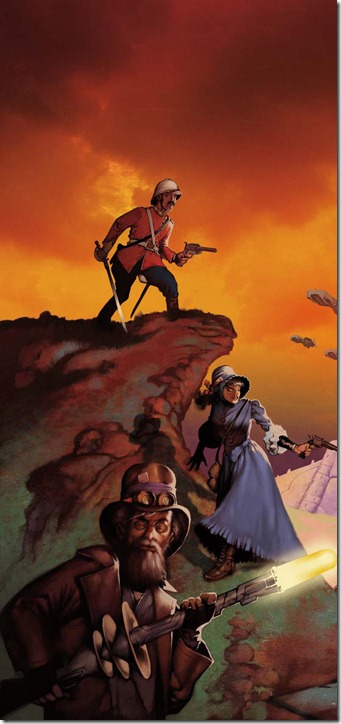
I decided to host a game of Space 1889, a steampunk adventure game in which the great Victorian nations sail the ether between planets in incredible steam-powered flying machines to encounter new life and new civilizations...then shoot the former and economically exploit the latter just like they did back on Earth. The game takes obvious inspiration from authors like Edgar Rice Burroughs, Julies Verne, H.G. Wells, and Sir Arthur Conan Doyle to create all-new adventures. The players assume the role of explorers and can even play as non-Earthling characters like Martians and Venusians.

I put out a call to other people who would be interested in playing and got responses from my two friends Melissa and David. Before the game session proper, we had a quick meeting via video conference to brainstorm a bit about what kind of adventurers their characters would be and how those strengths, weaknesses, and eccentricities would be expressed mechanically in the game system.

Melissa wanted to play a steampunk gadgeteer who had a bit of “Weird West” flavor to them. After spitballing some ideas, we came up with Hazel, a character that was exploring the world looking for the entrance to the “Hollow Earth,” a notion that reputable scientists in this world scoff at even though it would fit right in with their pulp-inspired universe. She is quite adept at both engineering and target shooting, so much so that when she lost a hand in an accident she incorporated a hidden revolver into the prosthesis. She also carries with her a bulletproof umbrella of her own design.

David seized upon the idea of making a character like Tarzan or Mowgli, a lost child raised in the jungle by animal guardians...but he wanted his feral foster parents to be sillier than apes or wolves. After kicking around some ideas around like Canadian beavers or Australian kangaroos, we decided that his character Reginald was an orphaned aristocrat raised by a flock of previously undiscovered extant giant terror birds. Brought back to civilization, the lost aristocrat becomes a popular curiosity among the upper crust and now he seeks to go to Mars to fly higher than either his human or his bird parents ever did.

Part of character creation was then giving numerical weight to the characters attributes. I don’t want to get too into the weeds on the mechanics of this but for those that are interested I used the Savage Worlds RPG system. To make a long story short, when a character wants to do something in the world, aim and fire a weapon, sneak past a guard, or learn the latest rumors going around the underworld, they roll dice to see if they succeed or not. These dice range from a four-sided die all the way up to a twelve-sided die. At character creation, the attributes that make a character, such as their intelligence or their skills like firearms, athletics, and diplomacy are assigned different kinds of dice. Low-sided for their weaknesses or skills they had little to no training in, and larger dice for skills and talents they are stronger in. Hazel the gadgeteer gunslinger had high intelligence and was skilled in abilities like marksmanship and engineering. Reginald the boy raised by giant birds had high number dice in skills like martial arts, athleticism, and intimidation but was unskilled in talents from the outside world like engineering or firearms.

The use of dice in RPGs (and especially dice other than six-sided dice) came about from a tradition of elaborate tabletop war games. Success or failure by roll of dice simulated the chaos of the battlefield: that sometimes strong battalions could fail or an underdog militia could have their day. To perform an action in this particular gaming system, say repairing a malfunctioning steam engine, characters are trying to roll a four or higher using their pertinent die. Hazel the mechanic with her eight-sided die in repair/engineering has a five out of eight chance of rolling that four or higher so the odds are in her favor. However she could roll a one to three, representing that the solution escapes her at this time, or she had dropped a tool and thus cannot fix the issue right now and must try again with a new roll on her next turn. Meanwhile Reginald, who knows nothing of machinery, would only be able to roll a lowly four-sided die with its paltry one in four chance of success. If he does roll that four, it appears that Reginald’s solution, giving the machine a good hard kick, brings the steam engine sputtering back to life by pure dumb luck.

While my players would be adventurers, I would be assuming the role of running the game as the Game Master or “GM.” Depending on what system or game you are using, the GM may be called anything from the Director, Storyteller, Umpire, or, in reference to Dungeons & Dragons, Dungeon Master (DM for short). That last one always sounded a bit too kinky for me to use personally but it’s pretty ubiquitous to the hobby at this point. The GM’s ultimate purpose mechanically is to present the players with a challenging scenario for them to have adventures in. Then, under this overarching goal, are various sub-duties and skills. The GM creates the starting point of the story or uses a story from the RPG book. The GM is then responsible for narrating what happens in the world, what the characters see, hear, smell, and touch, etc., and how their actions affect the world. The GM manages and interprets the game rules from the book and makes rulings on how the characters can get their desired outcomes. The GM also role plays other characters that the players interact with, friends, foes, monsters, random bystanders, shop keepers, etc. (These “non player characters” are referred to as NPCs). Finally the GM is making dice rolls on behalf of those NPCs as they interact with and even oppose the players.

For my game I had decided to run a short adventure of my own instead of a scenario directly from the game book. The premise was based on something I had half remembered from a chapter in a pulp adventure novel I read as a teen: the heroes would be trapped by a villain on a private train. The villain is playing their own version of The Deadliest Game, and each car of the train contains some obstacle or puzzle the heroes must overcome to get to the next car. I also set this up as a bit of meta humor because in gaming circles when a GM isn’t giving their players enough options or agency in the adventure they are said to be “railroading” the campaign. To further hang a lampshade on this I made the villain of the adventure, Dameian Mountebank, “DM” and gave him the characteristics and affectations of a bad micromanaging Dungeon Master crossed with Snidely Whiplash.

Of course if there is a danger of Game Masters railroading their players there is the opposite issue of players derailing or at the very least complicating the story by accident or design. For example, one of my players, David, was once the Dungeon Master in a game of Dungeons & Dragons in which I was a player. During part of the story, our characters were trekking through the wilderness and came upon an apparently abandoned small village. David had put that village there and if we had searched it our characters would have discovered clues that would be helpful later in the adventure. But I insisted that the party ignore the village and keep going to a larger settlement so we would be sure to get to the safety of high walls before nightfall and the rest of the players agreed. This then put David in the awkward position of either allowing us to continue, possibly without crucial information, or having to contrive other ways for us to discover it later. I have never lived this down.

But player improvisation, like the story beats created by the random dice rolls, is what makes this format of storytelling and gaming so unique. For example Dave and Melissa started changing my campaign, for the better, during character creation. I had originally envisioned my scenario as a simple introductory adventure that characters with no prior relationship to each other could be dropped into and then become a group. To maintain that surprise, during character creation I did not tell my players anything about the scenario their characters would be facing. As Melissa, Dave, and I brainstormed their characters, completely unprompted, the others started coming up with reasons why a gunslinger gadgeteer would be hanging around a feral aristocrat fostered by giant birds. Together, on the fly, they came up with a sort of prologue where Hazel had gone on an expedition to Reginald’s jungle island, reasoning that reports of wildlife thought extinct would lead her to the Hollow Earth where they would presumably have taken shelter from the great extinction eons ago. Reginald, impressed by Hazel’s ability to bring down large game with her firearms, agreed to reclaim his human family name and return to civilization. Now Hazel serves as a minder to Reginald as he re-integrates into human society and hopes that his notoriety will help fund further expeditions to prove that Earth and Mars contain vast underground habitats capable of sustaining humanoid life.

Now with the heroes created, we agreed to meet via webconference the following week to play through my scenario. And just how did the heroes fair against this dastardly murder train? Did my skills as a Game Master meet the satisfaction of veteran RPG hobbyists? What happens when man raised by birds encounters flash photography for the first time? For those answers and more, stay tuned to Nerds Who Read, for the final installment.

Kerey McKenna is a contributing reviewer to Nerds who Read and SMOF for the annual Watch City Steampunk Festival in Waltham, MA. Check it out at www.watchcityfestival.com.

Subscribe to Nerds who Read.

Photo Source(s): Stargazer’s World