Friday, August 24, 2018

For Teen Eyes Only

All Systems Red: The Murderbot Diaries by Martha Wells.
Hugo Award Winner—Best Novella.
Review by Michael Isenberg.

At some point in her adolescence, Martha Wells, future Hugo Award winner, decided that she was a robot. She couldn’t possibly belong to the same species as the uninteresting humans around her. It would be illogical to have any interactions with them beyond the minimum necessary to fulfill her programming. What she really wanted was to be left alone to read. Maybe watch TV. Streaming Anime would have been in the mix, but it was the 1970s and that wasn’t an option. In any case, the humans better not bother her because she has power that they won’t even see coming until it’s too late.

Okay, I confess. I made all that up. But it does explain how Ms. Wells was able to create such a compelling and believable protagonist to narrate her novella All Systems Red: The Murderbot Diaries. For all I know, it might even be true. Or maybe it wasn’t her who was a robot in her own mind. Maybe it was one of her children who I don’t actually know if she has. Or maybe she’s just that good and was able to create the character whole cloth from her imagination.

In any case, All Systems Red is a portrait of a robot who sounds and acts like a withdrawn teenager. It's fortunate that the character study is so skillful and lifelike, because the story doesn't have much else going for it.

The humans call the robot hero SecUnit, as in Security Unit, but it calls itself Murderbot. If you were hoping for a thriller about an undercover robot assassin though, you’ll be disappointed. Its mission is more mundane: to provide security for a team of scientists sent by the Preservation Alliance to survey an uninhabited planet. But it wants to be sure we know it could murder if it wants to.

Murderbot has little interest in its human teammates or their mission and does everything it can to distance itself from them. On away missions, it prefers to ride in the vehicle's cargo hold, rather than the passenger compartment. Although it is not required to wear its armor in most situations, it does anyway, in part to hide its body—the mishmash of organic and inorganic components is a source of poor body image—but mainly to hide its face. The opaque mask is ideal for that. Murderbot is convinced that “Nobody ever listens to me,” and yet, when the humans try to start a meaningful conversation with it, it freezes up in terror. All it wants to do is put in as little effort as possible so it can get back to “watching the entertainment feed all through the day cycle with no one trying to make [me] talk about [my] feelings.” It likes the entertainment serials “because they were unrealistic and not depressing and sordid like reality.”

Thus Murderbot tries to live a controlled existence, but as in real life, one can never control events. There is a second survey party, from some other alliance, on the other side of the planet. When the Preservation team loses contact with it, the humans go to investigate, bringing Murderbot along. They find the other party brutally murdered. Apparently someone else is on the planet, a third group, one with a mysterious and lethal agenda of its own. And now it’s coming after the Preservation team. Murderbot must work with its humans more closely than ever, if they are ever to leave the planet alive.

Amid the discussions of how to proceed (the humans are always discussing everything, much to Murderbot's annoyance), and the preparations, and the battles, Murderbot does come to care for its humans, even if it struggles to admit that. And right on schedule, two-thirds of the way through, Murderbot has a breakthrough. The team leader, Mensah, wants to see its face.

“I know you’re more comfortable with keeping your helmet opaque, but the situation has changed. We need to see you.”

I didn’t want to do it. Now more than ever. They knew too much about me. But I needed them to trust me so I could keep them alive and keep doing my job. The good version of my job, not the half-assed version of my job that I’d been doing before things started to kill my clients. I still didn’t want to do it. “It’s usually better if humans think of me as a robot,” I said.

“Maybe, under normal circumstances.” She was looking a little off to one side, not trying to make eye contact, which I appreciated. “But this situation is different. It would be better if they could think of you as a person who is trying to help. Because that’s how I think of you.”

My insides melted. That’s the only way I could describe it. After a minute, when I had my expression under control, I cleared the face plate and had it and the helmet fold back into my armor.

A touching moment. Murderbot literally comes out of its shell.

But beyond the Murderbot character, meh. The other elements of good fiction just aren't there. We know hardly anything about the rest of the team. Aside from Mensah, and the enhanced human Gurathin, who stood out because Murderbot didn’t particularly like him, we’re told so little about the members of the Preservation team that they are forgettable and interchangeable, like the dwarves in The Hobbit. We’re not even told what they look like. Murderbot only gives us the most bare-bones details of the settings. His style of narration is clear, but with nothing particularly interesting to distinguish it, not even a catch phrase, or the sort of techno-jargon one would expect from an artificial life form. And when the big reveal finally comes and we learn who the third party is and what they’re after, it goes by so quickly, and has so little relevance to anything, that it wasn’t worth the wait.

I suppose Ms. Wells would say that All Systems Red is a subjective, first person narrative, and these are things that aren’t important to the narrator, especially one as self-centered as Murderbot. And while she’d be right, they’re sure important for making that world come alive for the reader.

While Ms. Wells doesn't have time to flesh out the secondary characters, or tell us what the landscape looks like in any detail, she nevertheless finds time to check off all the political correctness boxes that I suppose have to be checked off to win a Hugo these days. Genderless protagonist. Check. Minority and/or female boss. Check. Same-sex relationships. Check. Non-traditional marriage. Check. Race/Class division. Check. Myopically profiteering corporation. Check. None of which has anything to do with the story, with the exception of the myopically profiteering corporation. In all fairness, that's a well-developed plot device for enhancing suspense: when things start going wrong, neither the characters nor the reader know whether they’re the result of shoddy equipment or sabotage. And at least we're spared the evil corporation cliché.

I'm sure All Systems Red appeals to the sort of self-obsessed adolescent (or permanent adolescent) who sees himself in the main character. And the Social Justice Warriors no doubt appreciate the virtue signalling. But I can't recommend it for hard core readers who want to get lost in a story. There's just not enough to get lost in.

It is clear from the last chapter that the adventures of Murderbot will continue, and indeed Ms. Wells has cranked out three more installments since All Systems Red launched The Murderbot Diaries sixteen months ago. A good character study can carry a short story. Carrying a novella is a stretch. I’m curious whether Ms. Wells will try to carry a whole series on its strength. Still, I’m in no hurry to find out. All Systems Red does not end on a cliffhanger, nor are there even any loose ends that my OCD absolutely needs to see tied up. And I don’t want to spend that much time with a surly teen anyway, no matter how artfully rendered. So it might be awhile. But despite their flaws, The Murderbot Diaries does have some popularity and they will no doubt be up for another award next year, in which case I’ll take a look. Stayed tuned.

Michael Isenberg drinks bourbon and writes novels. His latest book, The Thread of Reason, is a murder mystery that takes place in Baghdad in the year 1092, and tells the story of the conflict between science and shari’ah in medieval Islam. It is available on Amazon.com

Photo credit(s): Barnes & Noble

Wednesday, August 22, 2018

Building with Vibrations in the Air

No Time to Spare: Thinking About What Matters by Ursula K. Le Guin.
Book review by Michael Isenberg.

On the second night all the creatures woke, and the sleepless cricket was silent suddenly. The thunder spoke from ridge to ridge, from canyon to canyon, far, then nearer. Darkness split wide open to reveal what it hides. Only for a moment can the eyes of the creatures see the world in that awful light.

There is some fine writing in Ursula Le Guin’s collection of blog posts, No Time to Spare. No less than one would expect from a writer of her stature, or a book that won the Hugo Award this weekend for Best Related Work.

The late Ms. Le Guin—she died in January at the age of 88—disliked the term blog—“it sounds like a sodden tree trunk in a bog, or maybe an obstruction in the nasal passage,” she wrote. Nevertheless, her fellow octogenarian scribbler, Nobel laureate José Scaramago, inspired her to give blogging a try. The selections in No Time to Spare were written between 2010 and 2016. Their subjects run the gamut from daily life, to writing, to old age, to politics and economics. In between the main sections of the book there are a series of entr’actes, which narrate the adventures of her tuxedo cat. “His breed is Alley, his name is Pard./Life without him would be hard.”

As a former cat owner, I rather enjoyed “The Annals of Pard,” who only eats kibble. “I could put a piece of bacon on top of his kibbles and he would eat them and leave it. I could lay a filet of sole down on him and he would shake it off with contempt and go away.” Bacon and fish aren’t food. Only kibble is food.

The accounts of the non-cat parts of Ms. Le Guin’s daily life are equally entertaining. I was riveted by a four page instruction manual on how to eat a soft-boiled egg, thereby proving her claim in an earlier essay that a storyteller with “the narrative gift” “can take the stupidest, nothingest little event and make it into what copywriters call a gut-wrenchingly brilliant thriller and a laugh riot.” Granted, my fascination with the egg story had much to do with learning that the egg spoon is a thing. Discovering new breakfast utensils isn’t quite as big a thrill for me as discovering new cocktail paraphernalia, but it’s in the same ballpark.

No Time to Spare is not itself “a laugh riot”—Ms. Le Guin prefers sprinkling gentle humor throughout rather than indulging in ROFL comedy. Most of the essays are quite serious. But there is an amusing account of getting drunk with John Steinbeck and a couple tongue in cheek posts. A sarcastic lecture on the utter lack of imagination in modern swearing uses the f- and s-words in just about every sentence. Another essay, “Vegempathy,” calls out vegetarians for the cruelty they inflict on their food, what with the cutting and the boiling, not to mention the tearing apart with teeth. Only by subsisting on “the unsullied purity of the O in the atmosphere and in H2O” will humans be able to “live in true amity with all animals and all vegetables.” Sadly, any such movement “is fated to be, in each individual case, rather short-lived.”

Ms. Le Guin’s literary observations benefit from her being born at the right time to spend her young adult years in the '50s and '60s, when American liberals had woken up to the fact that there was great literature out there that wasn’t Western, but before they turned their back on the Western canon as the work of “dead, white males.” Thus, her discussion of plot structure is informed both by Homer (or “Papa H” as she calls him) and the Mahabharata.

The book takes its title from her musing about aging. When asked in a Harvard alumni survey what she did in her spare time, her response was, “What is Harvard thinking of? I am going to be eighty-one next week. I have no time to spare.” Her thoughts on the subject can be summed up as: the young have no idea what’s in store for them. So they should stop saying foolish things like, “You’re only as old as you think you are,” or telling the senior in their life who’s chronically in pain from sciatica about that ninety year old uncle who walks eight miles a day. “All I’m asking people who aren’t yet really old is…try not to diminish old age itself,” she writes. “Let age be age. Let your old relative or old friend be who they are. Denial serves nothing, no one, no purpose.” It seems she has come to terms with old age, with grace and equanimity.

She shows no such equanimity—or grace—when it comes to politics and economics however, and on those topics I found myself in disagreement with Ms. Le Guin more often than not. Her rant on the “racism, misogyny, and counter-rationality of the reactionary right” is such a cartoon that I wonder if she ever met an actual conservative. Growing up in Berkeley and making her home in Portland, perhaps not. An otherwise heartwarming story about a child who, thanks to a misunderstanding, thought there were horses in the bedroom, had to include a gratuitous dig implying that George W. Bush was Hitler. As with too much political writing these days, the double standards abound. Ms. Le Guin freely acknowledges that she was an angry Second Wave feminist during the 1970s. On the subject of getting angry, she writes, “We were right to do so…We were rousing people to feel and see injustice.” But two pages later, she calls the anger of the Tea Party an “orgy of self-indulgent rage” that threatens the survival of the republic. To her credit, she does call out her own team when she feels it has done wrong, in particular “Obama’s false figures and false promises in the first debate” with Romney.

Much of her anger is directed at capitalism, which she has long opposed in her writings. But despite Ms. Le Guin’s years of practice, No Time to Spare demonstrates no real insight into economics, merely colorful insults and tired clichés.

Capitalism is “fundamentalist” and “dogmatic,” she writes, capable of “providing security for none but the strongest profiteers.” It’s “social Darwinism—bankers red in tooth and claw.” Economic growth is a “tumor” and a “cancer.” Capitalism is synonymous with environmental destruction, as if we still lived in the 1950s and motorcycle couriers in Los Angeles have to wear gas masks. Never mind that the capitalist countries passed clean air acts while the communist countries, with no property rights, and therefore no concept of externalities, had the sorriest environmental records. Only socialism has promise, and even though it failed wherever it had been tried [at least she admits that], it would have been a great success if only it hadn’t been “run off the rails by ambitious men using it as a means to power, and by the infection of capitalism.” She can’t even praise the good work done by the Oregon Food Bank, without taking a swipe at Walmart, whose architecture has “the strangely menacing, fortresslike look of the great windowless citadels of consumerism,” [and which has fed far more people than the Oregon Food Bank].

I only noticed two instances in the entire book where Ms. Le Guin actually backs up her accusations with statistics. In one, she claims that under American capitalism, one in three children “aren’t always sure if they’ll get anything to eat today at all.” That statistic has been widely echoed on the left side of the political divide. But, in the first place, Ms. Le Guin doesn’t get it right: it’s one in five. And in the second place, it’s been completely debunked.

The other statistic she offers concerns income inequality during the years 2000 to 2007. From it, she makes sweeping generalizations that “increasingly, all economic growth benefits only the rich, while most people grow poorer.” Never mind that the Bush administration wasn’t particularly capitalist, or that income inequality data doesn’t actually show whether anyone is getting richer or poorer (it only shows relative wealth), or that those seven cherry-picked years aren’t representative of the 200-year history of capitalism.

What is representative of capitalism is literally billions of people lifted out of poverty. In the words of the Cato Institute’s Michael Tanner, writing in National Review:

Capitalism has done more to empower people and raise living standards than any other force in history.

Throughout most of human history, nearly everyone was poor. Even our wealthiest ancestors enjoyed lower standards of living than ordinary people in America today. It was not until the beginning of the 19th century that the masses started to enjoy real and growing prosperity.

What was the difference? Capitalism and its offspring, the Industrial Revolution.

Mr. Tanner offers a number of statistics to back up his claims, but few are as remarkable as this one from Arthur Brooks, president of the American Enterprise Institute:

It turns out that between 1970 and 2010 the worst poverty in the world – people who live on one dollar a day or less – that has decreased by 80 percent. You never hear about that.

It’s the greatest achievement in human history, and you never hear about it.

80 percent of the world’s worst poverty has been eradicated in less than 40 years. That has never, ever happened before.

So what did that? What accounts for that? United Nations? US foreign aid? The International Monetary Fund? Central planning? No.

It was globalization, free trade, the boom in international entrepreneurship. In short, it was the free enterprise system, American style, which is our gift to the world.

I will state, assert and defend the statement that if you love the poor, if you are a good Samaritan, you must stand for the free enterprise system, and you must defend it, not just for ourselves but for people around the world. It is the best anti-poverty measure ever invented.

As for the effect of capitalism on those who aren’t so poor, such as Ms. Le Guin—judging from the amount of travel she writes about, I gather she was reasonably comfortable—those profiteers she wrung her hands about mass produced her books and distributed them worldwide, thereby keeping her well-supplied with kibble and egg spoons.

Ms. Le Guin began her blog a month before the 2010 election, when the GOP took the House of Representatives and effectively shut down the Obama agenda. So it is not surprising, given Ms. Le Guin’s ideology, that No Time to Spare is grim in its assessment of our political future. And yet, as she is thinking about what matters, she comes to the realization that there are things more important than politics, a perspective we could all benefit from during these times of hyper-partisanship. After enjoying a couple live music performances, she writes, “I came away from both of these concerts marveling that while our republic tears itself apart and our species frantically hurries to destroy its own household, yet we go on building with vibrations in the air, in the spirit—making this music, this intangible, beautiful, generous thing.”

Michael Isenberg drinks bourbon and writes novels. For his own take on what America would look like without capitalism, check out his 2012 comedy novel Full Asylum, available on Amazon.

Photo credit(s): Amazon.com

Monday, August 20, 2018

Still Roaring

by Michael Isenberg

Congratulations to Wonder Woman, winner of the 2018 Hugo for Best Dramatic Presentation, Long Form, awarded last night in San Jose.

I still think, as I wrote last week, that Logan was by far the best science fiction movie of 2017, which is why I awarded it my NOT A HUGO Award. But sadly, it did not receive a nomination for the actual Hugos. Whether that was because it wasn’t sufficiently politically correct, or for some other reason, I’ll leave as an exercise for the reader. In any case, of the movies that were nominated (I’ll say it one last time: The Last Jedi? Seriously?), Wonder Woman was by far my favorite, and I’m glad to see it took home the silver rocket.

Here’s what I wrote about Wonder Woman when it came out last year. On reflection, I was concerned that perhaps, in my initial shock that the movie didn’t suck, my review was more glowing than the picture deserved. But I reread it today and I think I struck the right balance between the things that were awesome about Wonder Woman, and the things that needed improvement:

She is Wonder Woman: Hear her Roar!

Sorry about the title. My friend Kerey committed me to it in his Introduction to Wonder Woman here on Nerds who Read. He told the whole world that if the movie was good, that was what I was going to call my review. If it wasn’t, the title was going to be “Blunder Woman.”

So obviously it was good. In fact, it was awesome. Which disproves two beliefs that I've held for some time: 1) that Hollywood can’t make a good movie with a female superhero, and 2) that DC Comics can’t make a good movie with any kind of superhero.

Over the years, legions of female superhero movies have bombed at the box office. Conventional wisdom in Hollywood was that female superheroes just didn’t sell. Brainy pundits put their intellectual heft behind various theories as to why not; the theories ran the gamut from sexism to sexism. Apparently the audiences were sexist for not going to these movies. But IMHO, the reason the audiences stayed away was because these movies just weren't very good. Read more…

Michael Isenberg drinks bourbon and writes novels. His latest book, The Thread of Reason, is a murder mystery that takes place in Baghdad in the year 1092, and tells the story of the conflict between science and shari’ah in medieval Islam. It is available on Amazon.com

Photo credit(s): Indian Express

Saturday, August 18, 2018

High Definition Vision Quest

Hugo Nominee “Welcome to Your Authentic Indian Experience™” by Rebecca Roanhorse.
Short Story Review by Kerey McKenna.

Your name is Kerey McKenna. You are 33 years old, stand about 5’9”, have some flab around your middle, and have swarthy skin and dark curly hair which you attribute to your Brazilian heritage. And by heritage you mean to say that you are right off the boat Brazilian. Except in some ways you aren’t. Coming to the United States through an international adoption as an infant, naturalized as a toddler, and raised by a family with Irish/Swedish roots, your ties to Brazil are genetic, not cultural. You are a first generation immigrant, with a second or even third generation mentality. You are a Latin American immigrant, but you wonder sometimes if you represent an “authentic” Latin American immigrant experience. You lived it, it happened to you and surely others, but is that considered “authentic” if it’s not “expected” or “dramatic?”

You are also a nerd and write nerdy reviews of comic books, novels, and sometimes movies or TV shows for the blog Nerds Who Read. With the Hugo Awards coming up, and in order to not let your editor know how few of the nominees you actually read this year, you attempt to bang out as many reviews of them as you can during the week before the ceremony.

Scanning the short story nominees, one title catches your eye: “Welcome to Your Authentic Indian Experience™”. You think you might have an inkling of the story’s theme: the marketing of Native American culture as pop culture kitsch. Last year you saw the documentary Reel Injun on Netflix about the history of Native Americans (or often enough Europeans playing a fantasy version of Native Americans) in cinema. You recently caught up on HBO’s Westworld and you saw a slick internet video using Westworld as a jumping off point for the concept of “hyperreality”—art that creates experiences that blur the distinction between reality and artifice.

And even if “Welcome to Your Authentic Indian Experience™” doesn’t delve into any of these things, it already won a Nebula Award so you figure you aren’t going to pick a dud.

The story is written in the second person. You are told by the author, Rebecca Roanhorse, that you are now Jesse Turnblatt, a middle aged Native American man, who makes a living playing out virtual reality “experiences” of Native American culture for the benefit of white tourists. You are struggling to walk the line between fact and fantasy, history and myth, what is true and what is “authentic.” You find the use of second person narration by the author jarring. It is intimate yet dictatorial. Just like the virtual reality technology envelopes that offer tourist and tour guide the opportunity to inhabit the skins of others. Just like the way Jesse is told by forces greater than himself who he is and who he is not.

Writing up the review you realize just how much better Rebecca Roanhorse is at carrying a narrative in the second person than you are and you decide to drop the gimmick in 3, 2, 1...

Welcome back, dear readers. Kerey McKenna is once again me, myself, and I. You, dear reader are once again you, yourself, and, um, you, however and by whomever that might be defined.

“Welcome to Your Authentic Indian Experience™” is an enthralling short story about the complex struggle to separate reality from fiction and how blurry that line is on so many levels.

The protagonist, Jesse Turnblatt, is a Catholic Native American. There are factual historical reasons why a modern Native American man would have that European name and that religious affiliation. But to satisfy the tourists’ search for “authenticity” he adopts the alias “True Blood” and presents himself as a shaman leading his clients on vision quests, a tradition that he, like the white tourists, has never participated in himself and only knows by way of movies. Instead of his true visage of a man made soft by modern living, trying to make his next commission, the electronic simulacrum of the great American plains shows him as a virile and muscular noble savage content to provide sage spiritual guidance to whatever white person wanders his way. The region and tribe he presents to the tourists aren’t even his own; he grew up in a completely different part of the country. Yet even he feels comforted by the sights and smells of the kitschy vistas, and empowered by playing one of the cool Native Americans of the national subconscious. Yes, he considers it regrettable that his female co-workers often get pigeonholed into playing the fetishized “Indian Squaw,” but he rationalizes that they could all use the money and at least it’s Native Americans profiting on Native American stereotypes instead of someone else. Like Johnny Depp, whose lines Jesse memorizes. Or Iron Eyes Cody, whose picture he posted in his workplace.

No doubt my readers are familiar with Depp’s controversial role as Tonto in 2013’s The Lone Ranger, doing a lot of Jack Sparrow shtick, but with a bird on his head, inciting outrage that the part didn’t go to a Native American actor such as Zahn McClarnon (more about him later).

But perhaps it is necessary to step out of the story for a moment for some back story about Iron Eyes Cody. Iron Eyes was a Hollywood actor who played Native Americans in Westerns, his most iconic role being the non-speaking part of “Crying Indian” in a famous 1971 PSA about litter and pollution. Cody as the stoic Indian navigates his canoe through polluted streams and looks on as a once beautiful land is defiled by its new inhabitants. To many Americans, the tall and stoic Iron Eyes Cody, with his fringed buckskins, long black hair, and feathers blowing in the breeze is the very image of a Native American.

There’s just one problem.

Iron Eyes Cody was not Native American.

Well, he was, in that he was born in Louisiana, but to two fresh-off-the-boat Italians. Christened Espera Oscar De Corta, he moved to Tinseltown in the 1920’s and began making a living as an Indian in the movies, and living as an Indian from the movies. Citing memberships to various tribes, Iron Eyes always presented himself as a Native American and took to wearing his costumes and props outside the studio. He married a Native American woman, adopted two Native American children, and when asked would always deny that he was Italian.

Iron Eyes Cody was by no stretch of the imagination an authentic Native American. But “Kiksuya,” a recent episode of Westworld that may very well find its way to the Hugos next year, demonstrates that questions of authenticity and identity aren't always so cut and dry. Westworld is a sprawling Western-themed theme park staffed by incredibly lifelike robots, so lifelike they don’t know they exist only to amuse the super-rich tourists of the distant future. In “Kiksuya,” the focus is on Akecheta, a non-player character programmed to be a member of the fictional Ghost Nation tribe. Most of the dialogue in the episode is spoken in the Lakota Sioux language, including long monologues by Akecheta. He is played by Native American actor Zahn McClarnon, who is Sioux on both sides of his family (Lakota and Standing Rock respectively). McClarnon did not speak Sioux fluently enough to carry the dialogue and needed extensive training with language and dialect coaches. Which I as an audience member, not fluent in Sioux either, was completely unaware of as I was enthralled by the show playing out before me. To the producers, it was important that they not repeat the red face mistakes of the past and that they have Native Americans play Native Americans, even robotic ones.

But I have to wonder, as a naive consumer, could they have entertained me just as well if Akecheta had been speaking not Sioux but Navajo, or Esperanto, or Vulcan? [No one is entertained by Esperanto -ed.] If an actual Lakota speaker then spoke to me in Lakota and not Vulcan, would I question its authenticity, because it didn’t sound like what I heard on TV?

Which brings in the question of the role consumers play in the quest for “the authentic.” To what degree is that actually a quest for truth and to what degree is it a quest for affirmation and permission to keep believing in myths and stereotypes we hold dear?

To the fictional Jesse Turnblatt, Iron Eyes Cody represents a man who faked it 'til he could make it. But Iron Eyes's legacy as a European eclipsing actual natives in portraying natives still looms large over native actors, and perhaps Jesse is inviting calamity by thinking those days are over. They clearly aren't, as the casting of Depp in The Lone Ranger shows. If Iron Eyes and Depp were presumably taking parts from actual Native Americans, perhaps there is somebody out there who can be a better VR Indian than an IRL Indian. More authentic in their adherence to a myth than Jesse with his truths. If Jesse and McLarnon are not Indian enough to play Indians, what are they and who gets to decide that? And if they could still be brushed aside by a white actor for Indian roles, but considered too Indian to take parts created for whites, where does that leave them?

“Welcome to Your Authentic Indian Experience™” is a treasure trove of questions about experience, real and virtual, about identity, innate and borrowed, and about culture, genuine and imitation. I wish Rebecca Roanhorse luck in getting a Hugo award to put next to her Nebula award.

Please join us next week here at Nerds who Read, when we’ll look at the outcome of the Hugos and review some of the winners.

Kerey McKenna is a contributing reviewer to Nerds who Read and SMOF for the annual Watch City Steampunk Festival. Check it out at www.watchcityfestival.com.

Friday, August 17, 2018

Where No Superhero Has Gone Before

The First Annual NOT THE HUGO Awards.
Best Dramatic Presentation, Long Form: Logan.
Movie Review by Michael Isenberg.

Welcome back to the first annual NOT THE HUGO Awards. I’m your host, Michael Isenberg, Editor-in-Chief of Nerds who Read.

Congratulations to the “The Last Novelist (or A Dead Lizard in the Yard),” winner of the award for Best Short Story.

Our final category is Best Dramatic Presentation, Long Form, which is Hugo-speak for movies.

Logan is unlike any superhero movie I can remember, and certainly unlike any in recent years. Honest Trailers put it best, “In a cinematic universe known for its huge casts, CGI, and mixed-up timelines, an X-Men movie will rise above its peers, by saying, ‘F—k that. We’re doing our own thing.’”

Their own thing is a tale of superheroes confronting old age. The year is 2029 and Logan (Hugh Jackman) is a shell of his former self. Sure, he can still kick ass, as he shows us in the opening scene: He takes down a gang of hoodlums who attempted to strip his car (with him napping inside) and then shot him when he told them not to strip the chrome plating off the lug nuts. Three dead, one with a severed hand, another missing a leg. But afterwards, Logan feels the aches and pains of the fight a lot more acutely than he used to. The bullets don’t pop out as easily, the wounds don’t heal as fast, he’s alcoholic, he needs reading glasses, and, in what Cinema Sins calls “the most brutal ED joke ever,” he struggles to fully extend his trademark adamantium claws. “Seeing you like this just breaks my damn heart,” one of the villains tells him, not entirely facetiously.

And yet, Logan is in pretty good shape compared to Charles Xavier—Professor X (Sir Patrick Stewart). Weak and senile, constantly complaining that no one listens to him, and chronically in need of a shave for the sparse white bristles that stubble his chin, the ninety year old Charles is suffering, in the words of another of the villains, “a degenerative brain disease in the world’s most dangerous brain. What a combo.”

A fatal combo. Charles is prone to uncontrollable seizures in which he radiates waves of telepathic energy. Those who are merely immobilized by it are the lucky ones. Many are killed. The movie begins about a year after the “Westchester Incident,” in which one such seizure injured six hundred people and killed seven mutants, bringing the X-Men and Xavier’s School for Gifted Youngsters to an ignominious end. Not that there was much need for the school anymore. No mutants had been born for a quarter of a century.

Now Charles and Logan are on the lam. Charles is hidden away in a fallen water tower on an abandoned Mexican industrial site. Logan is driving a limo for asshole conventioneers and exhibitionist bachelorettes, trying to earn enough money to maintain the supply of black market drugs Charles needs to control his seizures. Not that Charles shows any gratitude. “I guess you prefer me pharmaceutically castrated, rambling like a lunatic,” he tells Logan. “So much easier for you.”

“I know, Pop,” Logan replies. “I’m such a giant disappointment.”

Into this sad existence, Laura (Dafne Keen) tears in like a whirlwind. An eleven year old Logan clone—his daughter, if you will—Laura was created unbeknownst to him in a laboratory run by the evil Alkali-Transigen Corporation. (Must it always be an evil corporation?) And lest you wonder how a man’s clone can be a girl, well, see the comic books—it's explained there. Laura has escaped from the lab and now needs Logan’s help to drive her to North Dakota where she is supposed to rendezvous with the other escapees and cross over to Canada and safety. Or at least that’s the plan the nurse who helped her escape “read about,” apparently in an X-Men comic book. Logan is skeptical. But, following in the tradition of reluctant heroes that runs from Hamlet to Casablanca and beyond—he piles into the limo with Laura and Charles, and they start their drive north, an army of heavily armed, generously funded, and well-connected Alkali-Transigen henchmen hot on their trail.

Laura first appeared in Marvel Comics in 2004 as X-23. “Old Man Logan” made his pen and ink debut four years later. As in the movie, comic book Old Man Logan lives in a future dystopia where most of his friends and loved ones have died. Tired of being a hero, he travels the country with a sidekick (albeit it’s the blind Hawkeye rather than the senile Charles). But that’s where the resemblance ends and we must look beyond the comics for the movie’s inspiration.

Director James Mangold reportedly acknowledged creative debts to other road movies set in the American West, specifically Little Miss Sunshine and The Gauntlet. The Western, in general, is also an obvious influence, what with the wide open desert and mountain vistas seen throughout Logan, and the Spaghetti Western, in particular, with it gritty reality, which manifests in 2029 as dust, rust, and truck stops. The Western influence is explicit in a scene where Charles and Laura watch 1953’s Shane. This being a movie, the words uttered on the TV are improbably apropos to Logan’s struggle to leave his days of hurting people behind him—even when the hurt is in the name of heroism:

A man has to be what he is, Joey. Can't break the mold. I tried it and it didn't work for me…There's no living with...with a killing. There's no going back from one. Right or wrong, it's a brand. A brand sticks. There's no going back. Now you run on home to your mother, and tell her...tell her everything's all right. And there aren't any more guns in the valley.

The old man taking one last road trip is another well-worn trope that also clearly influenced Logan. As with the protagonists of Harry and Tonto, About Schmidt, and The Straight Story, the open road teaches Logan, as he approaches his end, what it was all about. The twist here, of course, is that the old man is a superhero.

And yet, the superhero movie is one genre that didn’t influence Logan.

Today’s superhero movies are painted big on the canvas: Gargantuan budgets in the $300 million range. Massive crossover events in which dozens of characters team up, for evil, or for good. Technology so advanced that the characters themselves argue over whether it’s science or magic. Extra-formidable villains with godlike powers. Some are even actual gods like Loki. All have ambitious plans to rule—or destroy—the universe, or at least vast swaths of it. Wagnerian soundtracks. And CGI. Lots and lots of CGI. CGI stunts that defy physics. CGI planetscapes with brilliant colors and more suns than you can shake a stick at. CGI characters who barely resemble anything human. CGI ‘splosions in which the CGI White House or the CGI Palace of Westminster is vaporized in a blaze of CGI firepower. And, in the case of last year’s Justice League, even a CGI upper lip to erase the mustache that Superman actor Henry Cavill was unwilling to shave.

I’ve long contended that CGI has ruined movies by substituting spectacular special effects for boring old fundamentals like plot, character, and dialog. Logan proves me right, by showing what a movie can be if it dials down the CGI a notch or ten. Logan is more of a small canvas, with a budget of “only” $97 million. It bucks all the other superhero movie trends as well. The technology of 2029 is little advanced over 2017, the only significant development being the widespread deployment of self-driving trailer trucks. The villains are just men who want the mutants under their control. One or two have cybernetic enhancements, but that’s the extent of their powers. None can fold time or wipe out half of human life with a snap of his fingers. The background music is subdued, often little more than mournful chords that evoke rain sliding down window panes. Long stretches of the film have no background music at all, which, incidentally, makes it a lot easier to hear the dialog.

The result is so incredible that the professional trolls on YouTube were at a loss as to how to make fun of it. Pitch Meeting hasn't even tried yet. Jeremy on the “Everything Wrong with Logan” video deducted eight sins, half of them for girl-Wolverine’s awesomeness and bad-assery. Don’t know if that’s a record, but it’s got to be up there. How it Should Have Ended had to pad its runtime with a nearly five minute X-Men musical number in the style of Les Miserables, an homage to another Hugh Jackman role. “Damn, this movie’s hard to make fun of,” Honest Trailers’ Epic Voice Guy lamented. “I got to call in some help.” He tries to enlist Deadpool, but the King of Snark refuses to play along: “Are you high? I’m not going to s—t on Logan. That film is a f—king masterpiece.”

It really is. Just the fact that they managed to put a kid in an adult franchise without having her be annoying (“Now this is pod racing”) is an accomplishment. As for the father-son relationship between Logan and the Professor, it’s an emotional wallop. This scene in which Logan carries Charles to his bed and tries to give the resistant professor his pills, is simultaneously funny and heartrending:

Logan: How about you blow on them to make them safe.

Charles: F--k off, Logan.

Logan: So you remember who I am now.

Charles: I always know who you are. It’s just sometimes I don’t recognize you.

Logan: Take the pills.

Despite his gruff exterior, I can’t help noticing that Logan takes the most tender loving care of the Professor. And even though nothing Logan ever does is good enough for him, in his more lucid moments, i.e. when he’s not shouting advertising copy for the Taco Bell quesalupa, the Professor is determined not to let his role as Logan’s teacher slip away. “You know, Logan,” he tells him, during the film’s Hawkeye’s Farm in Iowa moment, “This is what life looks like. A home. People who love each other. Safe place. You should take a moment and feel it…Logan. Logan! You still have time.”

As it happened, I first saw Logan during my own father’s final months. And although dad was never as dependent as Charles, the movie hit home hard. Writing this review has gotten me choked up more times than I care to admit.

I freely acknowledge that I may be biased by those personal circumstances, but I really think that Logan was not only the best science fiction movie of 2017, it was the best 2017 movie of any genre. Mr. Jackman and Sir Patrick’s performances were Oscar-worthy, a fitting curtain call for their seventeen year run as Wolverine and Professor X. Sir Patrick was so committed to his part in Logan that he lost twenty pounds to prepare for it. "I wanted to look sick and undernourished and stressed and frail and vulnerable," he told Variety. Alas, the hidebound Academy couldn’t see past Logan’s comic book origins. The movie garnered only a single B-list nomination, Best Adapted Screenplay and it didn’t even win that. I expected the Hugo Award voters, rooted in science fiction, to be more receptive, but they too gave Logan the snub. (I'll say it again: The Last Jedi? Are you serious?!) No doubt Logan didn't have enough about global warming.

But to redress these injustices is why I started NOT THE HUGOS, and I’m delighted to present the final award, Best Dramatic Presentation, Long Form, to Hugh Jackman, Sir Patrick Stewart, and Logan.

Tune in tomorrow to Nerds who Read, when Contributing Reviewer Kerey McKenna will review another of the actual Hugo nominees, Rebecca Roanhorse’s short story, “Welcome to your Authentic Indian Experience™.” And join us next week, when we’ll look at the outcome of the Hugos and review some of the winners.

Michael Isenberg drinks bourbon and writes novels. His latest book, The Thread of Reason, is a murder mystery that takes place in Baghdad in the year 1092, and tells the story of the conflict between science and shari’ah in medieval Islam. It is available on Amazon.com

Thursday, August 16, 2018

Extra! Extra! Read all about it!

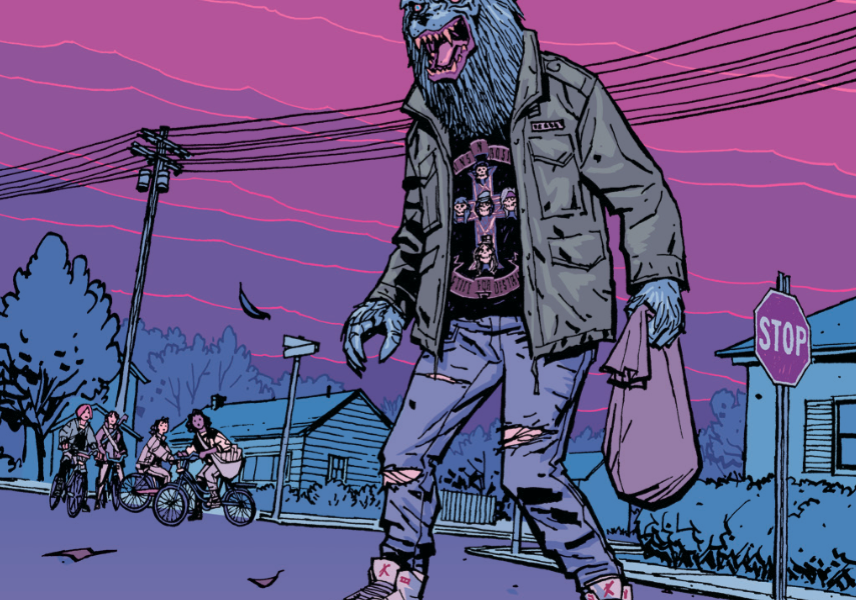
Hugo Nominee Paper Girls. Written by Brian K. Vaughan. Art by Cliff Chiang and Dee Cunliffe. Lettering by Jared K. Fletcher.
Graphic Novel Review by Kerey McKenna.

Recently I was scrolling through my Facebook feed when I noticed Cynthia Shaffer over at Reel Urban News had posted a question to her friends: under a picture from Sandlot, a movie about adolescent boys in the 60’s playing pick-up baseball, a movie that I will remember forever, forever, FOREVER, Ms. Shaffer asked, “The Sandlot. Stand By Me. The Wonder Years. Little Rascals. I have a question. Why aren't there any movies/shows like those with girls?” And there were some interesting responses.

Some completely missed the point and named stories about groups of kids that have one or two girls in the group. Some pointed out stories about individual young women (Annie, Ann of Green Gables, or My Girl) that center around a female lead but aren’t really an ensemble of young women. Others, myself included, listed TV Shows, books, and cartoons that did deal with groups of young women (Little Women, Facts of Life, Babysitters Club, and My Little Pony: Friendship is Magic). Some commentators posited that there are fewer stories because adolescent girls don’t roam around having adventures in packs the way adolescent boys do. They argued that even when girls form into cliques the relationships are complicated mixes of friends, frenemies, and enemies in constant internal and external conflicts that would stymie Niccolo Machiavelli.

It was this discussion about the dearth of nostalgic stories about roaming girls having adventures that made the title Paper Girls jump out from the list of this year's Hugo nominees for best Graphic (i.e. Comic Book) Story. Cynthia, I found it: Stranger Things, but all the heroes are girls.

Volume 1 begins in the small town of Stony Stream, Ohio in the wee hours of November 1st, 1988, a time of transition for our heroines and for our culture. It was a time when most people still got their news from print media and people entrusted daily delivery of their morning paper to enterprising children. In the 1980’s, before sensationalism around “Stranger Danger” kept more children home under the watchful eyes of helicopter parents, it’s easy to imagine “Free Range Children” pedaling across town on BMX bikes getting into all manner of misadventures.

Traditionally November 1st is also when All Hallows Eve, the night of the infernal hedonism, gives way to All Saints Day, a time of religious reflection and prayer. But for four tween-age girls with paper routes, it is “Hell Morning.” Halloween hasn’t really ended yet and their usual routes are littered with TP and roaming gangs of teenage boys still looking to cause mischief and mayhem.

THRILLER! DILLER NIGHT!

Seeking safety in numbers, four paper girls team up to make their appointed rounds. There is Mackenzie “Mac” Coyle, who became the town’s first paper girl when she inherited a route from her brother. Rough around the edges and from a troubled home, she seems to have picked up all the bad habits that the boys over at Stranger Things were spared to make them more marketable to modern audiences. Karina, “KJ,” is Mac’s lancer and never goes anywhere without her trusty field hockey stick. Tiffany Quilkin is the nerd of the group, racking up high scores on her NES and supplying the group with expensive CBs from Radio Shack. The “New Kid” is Erin Tieng, who has very vivid and surreal (perhaps prophetic?) dreams.

In the pre-dawn hours of post-Halloween, the girls will face things much more dangerous than gangs of teenage hoodlums: mysterious hooded figures stealing electronics, unaccountable artifacts in suburbia, knights in shining armor that speak in text message shorthand, and beings from the fourth dimension with alien geometries. As a wise man once said “strange things are afoot at the Circle K.”

The girls, and the reader, are always kept on edge as the bizarre goings-on escalate in frequency and danger. Volume 1 ends with a cliffhanger that had me immediately tapping the button on my Kindle to buy the next volume. And the one after that and the one after that. I have not been this excited for the next installment of 80’s sci-fi since Doc Brown whisked Marty McFly away in a flying Delorean.

I’d love to start talking about the rest of the series...including the current Hugo nominee, Volume 3, but the surprises and plot twists are so exciting I would hate to spoil them.

With the success of Stranger Things and the It remake (the argument about which one ripped the other one off is a snake swallowing its own tail), I’m sure we are in for more period pieces about kids on bikes fighting the supernatural, with a Greatest Hits of the ‘80s soundtrack. To dismiss Paper Girls as a mere gender-swapped gimmick riding the coattails of better works would be a double disservice. A disservice to an excellent work of science fiction/horror and a disservice to yourself for not reading it and robbing yourself of the experience.

Volume 1 was a Hugo finalist last year but lost out to Marjorie Liu’s Monstress. Here’s hoping that Volume 3 takes the silver rocket on Sunday.

In the meantime, stay tuned to Nerds who Read for more NOT THE HUGO Awards from Editor-in-Chief Michael Isenberg, along with more reviews by me of actual Hugo nominees.

Kerey McKenna is a contributing reviewer to Nerds who Read and SMOF for the annual Watch City Steampunk Festival. Check it out at www.watchcityfestival.com.

Wednesday, August 15, 2018

An Idyllic Planet to Make a Good End

The First Annual NOT THE HUGO Awards.
Best Short Story: “The Last Novelist (or A Dead Lizard in the Yard)” by Matthew Kressel.
Review by Michael Isenberg.

Welcome back to the first annual NOT THE HUGO Awards. I’m your host, Michael Isenberg, Editor-in-Chief of Nerds who Read.

Congratulations to the Orville episode, “Majority Rule,” on winning the award for Best Dramatic Presentation, Short Form in my last post.

Our next category is Best Short Story.

Any attempt to single out one science fiction short story as the best of a given year is a Herculean task. The Internet Science Fiction Database shows over 14,000 short fiction entries for 2017, up from around 10,000 at the beginning of the decade. No one can possibly read even a significant fraction of them, much less do justice to picking the top one.

Nevertheless, one stood out for me. It doesn’t promise to solve the world’s problems, merely touching on the question of whether anyone reads anymore. It doesn’t portray the human race in an epic battle for its very existence. It doesn’t even delve into the dark recesses of the human psyche. It’s just a nice story about a friendship between a little girl and an old man. But then, these days niceness is underrated.

The story is “The Last Novelist (or A Dead Lizard in the Yard)” by Matthew Kressel. Published on Tor.com, “The Last Novelist” was nominated for a Nebula Award, but sadly did not make the finals for the Hugos, which will be awarded in San Jose this weekend.

Reuth Bryan Diaso is hopelessly out of step with his times. A novelist in a future where no one knows what a novel is, much less reads one, he hasn’t sold a book in twelve years. I don’t mean he hasn’t sold the rights to one to a publisher. I mean he hasn’t sold a single copy of a book. “The last person to request one of my printed books was an Earth antiquities dealer on Bora,” he tells us, “who carefully sealed my book in plastic and placed it in storage, where it would serve as an example to future generations of what paper books had been like. As far as I could tell, the dealer had no intention of ever reading it.” Still, Reuth continues to churn out novels. Rather than transmit his dreams into a “neural,” by means of the link to the “Wee” that everyone seems to have implanted in their brains, he laboriously writes them out in cursive, pen and ink on paper. Then he manufactures the books himself on an old-fashioned press with hand-typeset print. When asked why he keeps writing novels that no one reads, he replies like a true artist: “I can’t stop.”

Now 91 years old and sick, he comes to the planet Ardabaab to die. He has arranged a house there, he says, “a squat blue bungalow near the beach set among wind-whipped fields of sugarcane and towering coconut palms. Forty minutes later I was splayed on the empty beach while Ardabaab’s red-dwarf sun—rock-candy pink at this late hour—dipped low over the turquoise sea, the most tranquil I had ever seen. For a station-born like me, it was utterly glorious.” An idyllic planet to make a good end.

But first he is determined to finish his last novel, a story about a woman who comes to a planet to look for someone she loves. It’s giving him trouble, but he plugs away. Writing on the beach his first morning on Ardabaab, Reuth attracts the attention of numerous Persons from Porlock (look it up), but also a young girl whose curiosity is whetted by a desire to know what Reuth is “drawing.”

The girl is called Fish, not her real name, but her favorite thing to do is “Watching from my undersea bedroom the way the fish change colors as the sun rises.”

Reuth explains writing to her and she disappears into the sea and home. But by afternoon she returns—and several more times after that—with more questions for Reuth. A friendship blooms between them as the conversation expands from novels and novel writing, to printing and typesetting, and eventually to love and loss. Reuth discovers that Fish has quite a talent for drawing and offers to let her “hill-a-straight” his book. She accepts. He also teaches her typesetting—on a press he sets up in the spare bedroom of his bungalow—and the book, whose words now come easily to Reuth, becomes a collaborative effort.

I don’t want to give any spoilers as to how it ends, but I confess I got a little teary-eyed.

The writing is imaginative, alive with the bold colors of the tropics. Mr. Kressel hits the right balance on style: the slightly ungrammatical speech of the inhabitants of Ardabaab gives us a sense that we’re in the islands, without overdoing it and taking us into Jar Jar Binks territory. Similarly, there’s enough techno-jargon to ground the story in the future, without so much as to make things confusing as to what’s happening. Yiddish expressions are sprinkled throughout, which one wouldn’t expect to work in this setting, but someone it does.

Which leaves one loose end—the dead lizard. Reuth found it under his shoe in the opening lines. He’s not sure how it got there, whether he stepped on it, or whether it crawled underneath during the night. As the story unfolds, its carcass turns up from time to time in progressive states of decay, until it eventually disappears all together. It obviously symbolizes something, although I was puzzled as to what. The dead art of novel writing? Reuth’s struggle to write his last book? Reuth himself? Apparently Reuth doesn’t know either, although he’s sure it’s trying to tell him something. I think I finally figured it out, but it took me a while.

All in all, a sweet and well-written tale. I have a soft spot for genuine friendships and people out of step with their times. Which is why I’m delighted to award “The Last Novelist” with the NOT A HUGO for Best Short Story.

Stay tuned to Nerds who Read all week for more NOT A HUGO Awards with yours truly, along with write-ups of some of the actual Hugo nominees by Nerds who Read Contributing Reviewer Kerey McKenna.

Michael Isenberg drinks bourbon and writes novels. His latest book, The Thread of Reason, is a murder mystery that takes place in Baghdad in the year 1092, and tells the story of the conflict between science and shari’ah in medieval Islam. It is available on Amazon.com

Photo credit(s): Michael Isenberg