Wednesday, July 27, 2016

Look! Up in the sky! It’s a bird! It’s a plane! NO! It’s a DEADBEAT DAD!

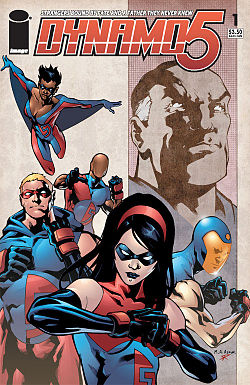
Dynamo 5. Created by Jay Faerber and Mahmud Asrar
Graphic Novel Review by Kerey McKenna

With his iconic blue, red, and yellow costume (bearing a strong resemblance to a certain Man of Steel), the superhero Captain Dynamo fought crime around the world and in his home territory of Tower City for decades. His five signature superpowers—strength, flight, super vision, telepathy, and shapeshifting—not to mention his good looks and natural charisma, made him one of earth’s most powerful and well-respected superheroes. Until the day he died, anyway, in a seedy motel room, most likely while engaged in one of the many clandestine extra-marital affairs he had throughout his career.

Maddie Williams, Captain Dynamo’s widow and former ace reporter, is devastated on three fronts: the death of her beloved husband, the discovery of his years of philandering, and the prospect that in his absence supervillains will run roughshod over a defenseless Tower City. Determined to find new champions, Maddie puts her investigative skills to the test to discover if her husband left any secret…legacies. And she discovers five young people, each a reminder of her husband’s infidelity, each having grown up in a different background, each possessing one of her husband’s superpowers, and each with the potential to be a great hero—if only they can work with the other four:

  • Bridget Williams: A young, disillusioned screenwriter who, like many, went to Hollywood seeking fame and fortune but so far has only fallen into a dead end job. However, her unassuming and pale gothic looks disguise that she inherited her father’s super strength. Willing to roll up her sleeves as the team bruiser, she is…Scrap.

  • Olivia Lewis: Overachieving student at Georgetown University, she soars through the sky as…Slingshot.

  • Hector Chang: A bookish high school student in Vancouver who is, unfortunately the victim a bully right out of central casting. Thanks to his coke bottle glasses, Hector has no romantic prospects. But just maybe, after his super vision develops (x-ray vision and optic blasts), he’ll see a way out of his miserable school life. He is…Visionary.

  • Gaige Reinhart: the polar opposite of Hector. Tall, all-American hero of his small Texas town, lineman for the football team, he is literally the Big Man on Campus. His brute force tendencies are a stark contrast from the power he inherited from his father, the subtle skill of telepathy. He is…Scatterbrain.

  • Spencer Bridges: the most mysterious member of the novice superhero team. After a troubled and tumultuous childhood in the American foster care system, the adult Spencer became a ladies' man and grifter. His dubious vocations dovetail with his inherited power of shapeshifting. He will be the team’s espionage ace in the hole as…Myriad.

    Together they form—The Dynamo 5!

    With this novel premise and diverse cast, creators Jay Faerber and Mahmud Asrar launch a high-flying adventure that is equal parts bold classic superhero tale and modern deconstruction of the same genre. Unlike some such deconstructionist melodramas, Dynamo 5 does not apologize for being a story about superheroes: the costumes are bold to the point of garish, the greatest threats to the city can be defeated with a sound thrashing, and, most importantly, despite all the danger, this world would be thrilling to inhabit. The deconstruction comes from examining the human element of this world of magic, mad science, and aliens, and playing with standard superhero tropes. The late Captain Dynamo, in public a mighty defender of truth and justice was, in reality a cheating heel and deadbeat father to the children that resulted from his serial indiscretions. His widow, having formerly played the role of damsel in distress, now calls the shots for a team of superheroes. And each of the Dynamo 5 has a distinct personality and interpretation of what it means to be a superhero and the child of a famous father they never knew.

    While the dialogue in the first several chapters can be somewhat heavy on exposition, it’s balanced by an engaging plot with lots of twists and turns. It says a lot that while the big two comic book companies attempt to maintain interest in their well-established characters with ever more convoluted reboots, re-imaginings, retcons, and recastings, Dynamo 5 is able to do so much with a completely new cast. Thanks to the great art team and the engaging premise, I couldn’t put down the first volume, Post-Nuclear Family. Then I raced through the next four volumes in the course of a weekend. As far as I can tell, that’s the entire run, although I hope it’s just the entire run available in trade paperback. Volume 1 has a fairly complete story arc so I would highly recommend picking it up to enjoy either as a standalone adventure or as the introduction to a bold world full of potential.

    Kerey McKenna is a contributing reviewer to Nerds who Read and SMOF for the annual Watch City Steampunk Festival in Waltham, Massachusetts. Learn more at www.watchcityfestival.com.

  • Tuesday, July 19, 2016

    Dynamic Duo—Radio and Superheroes

    Red Panda Adventures. Written and Directed by Greg Taylor. Performed by the Decoder Ring Theatre cast
    Review by Kerey McKenna

    [Organ music]

    “OLD TIMEY” RADIO ANNOUNCER: And now Decoder Ring Theatre presents the continuing adventures of Canada’s greatest superhero, that scourge of the underworld, hunter of those who prey upon the innocent, the marvelous masked mystery man known only as THE RED PANDA. The Red Panda, mysterious crusader for justice, hides his true identity as one of the city’s wealthiest young men, in his never ending battle against crime and corruption. Only his trusted driver Kit Baxter, who joins him in his quest in the guise of the Flying Squirrel, knows who wears the mask of the Red Panda!

    The adventures of the titans of the 1930’s-1950’s Golden Age of Comic Book Super Heroes weren’t always bound up on the printed page. Many of their stories where carried by the dynamic duo of comic books and radio. The Shadow, the Green Hornet—even Superman himself (a mere 2 years after his debut on newsstands)—all had beloved and long running radio dramas. Radio and comics make an odd yet complementary pairing: Comics are a visual medium that can only convey noises through artistic cues. Radio uses voice acting to paint vivid pictures in the mind’s eye. The radio shows of yesteryear weren’t merely ephemeral tie-ins chasing the success of the comics. They made significant contributions to the lore of each hero. It was Orson Welles’s chilling performances that promised listeners that the mysterious Shadow knew what evil lurked in the hearts of men. Radio introduced such mainstays of the Superman mythology as Kryptonite, Daily Planet editor Perry White, and photographer/cub reporter Jimmy Olsen.

    However, when radio dramas by and large left American airwaves, eclipsed by the post-war television boom, superheroes either jumped on the exodus to the small screen (a la Superman, Green Hornet, and Batman) or returned to the comic books, newspaper strips, or pulps from whence they came. Fortunately, a small audio dramatic group based out of Canada, Decoder Ring Theatre, has resurrected the radio superhero serial with Red Panda Adventures, a long running series of super heroic adventures, in the form of radio plays, available for free streaming or download from their website, and the subject of this week’s installment of “I Read this…with my Ears.”

    The Red Panda himself is equal parts Green Hornet and the Shadow. With a dapper suit, fedora, and red domino mask, his genius-level intellect and vast family fortune allow him to deploy an arsenal of weapons in his war against crime, such as a personal auto gyro, static shoes that cling to walls, and miniaturized radio equipment that is cutting edge for the 1930’s. But his greatest weapon against crime is his powers of hypnosis. In an homage to the Shadow, the Red Panda, after years of study abroad in the mystic arts, has the power to influence the minds of others. He can taunt and confuse criminals by making phantom doppelgangers of himself appear all over a room to sow confusion and draw their fire. Like the Green Hornet, the Red Panda goes into battle with his martial artist valet. In this case, that's his driver, Katya “Kit” Baxter, a sassy redhead who is as aggressive on the road as she was in her father’s boxing gym. Much of the humor of the series comes about because Kit would like to be partners in more than just crime fighting with her employer and mentor (The Red Panda is voiced by series creator Greg Taylor and Kit is voiced by his wife Clarissa Der Nederlanden-Taylor).

    The series begins in the Great Depression as the heroes defend Toronto from crooks, gangsters, and costumed supervillains, giving the city a fighting chance to recover from the economic downturn. Next, World War II, a weird war where Nazis have deployed ancient magic, dinosaurs, and all manner of sci-fi weaponry to fend of the Allies’ Super Services (the superheroes and adventurers of the combined Allied nations). Eventually the postwar years arrive. Mystery men bow out into retirement and hand the keys to the city to the garish “caped crusaders” of the Silver Age.

    Red Panda Adventures are fun for casual listeners and a must-listen for fans of audio drama or superheroes. It’s got the corny earnestness of the classic Adam West Batman series, the morals of classic Dragnet, and the romantic banter of the Nick and Nora Charles mysteries. From the intro music to the Foley sound effects, the Decoder Ring Theatre audio drama troop are dedicated to putting out rip-roaring superhero adventures on a shoestring budget. Like the radio plays of old, a small band of actors plays a large cast of characters. An actor playing a friendly beat cop one week may be featured as a supervillain the next. And in a time when superheroes of the big screen might be considered indifferent to the plight of civilians in the cities that they blow up, the Red Panda and the Flying Squirrel are unambiguous about why they don their costumes. The Red Panda began his crusade out of a sense of noblesse oblige. The Flying Squirrel, who grew up in Cabbage Town, the working class section of Toronto, knows what it’s like to be one of the downtrodden masses; she wants to put a well-placed punch to the face of any racketeer, supervillain, or otherworldly dimensional terror that would make life harder for the blue collar masses.

    If, after listening to a few episodes, you decide that Red Panda Adventures scratch your itch for superhero thrills, I also recommend the four prose novels available for purchase. These are available in print, e-book, and audiobook; the latter is narrated by the author and Red Panda himself doing an excellent one-man rendition of the entire cast. The creators have also begun a series of proper comic book adventures available for digital download from Comixcology.com but they assume a bit of familiarity with the characters that would best be appreciated by people with a couple of seasons of the radio show under their utility belt.

    So if you’re ready for excitement, turn your dial to Red Panda Adventures. Only at DecoderRingTheatre.com

    Kerey McKenna is a contributing reviewer to Nerds who Read and SMOF for the annual Watch City Steampunk Festival in Waltham, Massachusetts. Learn more at www.watchcityfestival.com.

    Friday, July 8, 2016

    No Premium on Fun

    Review of The Adventures of Tom Stranger, Interdimensional Insurance Agent
    Audio Book by Larry Correia, Performed by Adam Baldwin
    Review by Kerey McKenna

    Welcome dear Nerds Who Read regulars to my new series of reviews, “I Read This…With My Ears,” where I will be reviewing audio dramas and audio adaptations of literature, as a change from my usual reviews of graphic novels. My first review will be of an odd little sci-fi farce I came across during an audiobook sale for my Amazon Fire, The Adventures of Tom Stranger, Interdimensional Insurance Agent. Written by Larry Correia, it is read by Adam Baldwin, who for Firefly fans is the man they call Jayne, and for followers of The Last Ship, XO Mike Slatterly. Tom Stranger works because of Baldwin's vigorous, over-the-top dramatic reading.

    What happens if assassins from a parallel dimension are coming after you as a way to get at your much more successful parallel dimension doppelganger? Is your dimension being invaded by platoons of Nazi dinosaurs? Then you better hope that you’re covered by Stranger & Stranger Interdimensional Insurance. In providing consummate customer service, Tom Stranger serves as actuary, bodyguard, and general man of action to defend his clients from bizarre dangers from all around the multiverse. And it is a bizarre and dangerous multiverse indeed, brimming with more over-the-top testosterone-fueled spectacles than John Cena juggling chainsaws while riding a dirt bike over a pit of alligators. Unfortunately, a clerical error has saddled Tom with Jimmy the intern, a slacker coasting his way to a degree in Gender Studies who would be better suited to the soul-numbing drudgery of a telemarketing call center operator than the mental and physical rigors of an interdimensional man of action.

    It is said that comedy is one of the hardest forms of drama to pull off and I have to credit the chuckles that Tom Stranger does get to Baldwin’s narration. Whether playing the taciturn Tom Stranger, his helpless slacker sidekick, a smarmy business man, a manatee CPA, or himself (in a parallel universe where Baldwin's TV role as a “libertarian cowboy” led him to the Oval Office), Baldwin performs with an infectious sense of fun. Baldwin is an outspoken conservative in left coast Hollywood, and his and Correia’s regular jabs against leftist politics and the Obama administration are not so much vicious barbs as big lemon meringue pies to the face lobbed by self-professed clowns.

    As far as sci-fi satire audio dramas go this will not challenge the audio adaptations of Hitchhiker's Guide to the Galaxy but with a run time of just over two hours (which is brisk as far as audio books go) and priced to move on Audible, it might be worth a listen if you are in the mindset for a bit of mindless fun.

    The Adventures of Tom Stranger, Interdimensional Insurance Agent is available on Audible.

    Kerey McKenna is a contributing reviewer to Nerds who Read and SMOF for the annual Watch City Steampunk Festival. Learn more at www.watchcityfestival.com.

    Monday, July 4, 2016

    Patriotism--from the Left

    1632 by Eric Flint
    Book Review by Michael Isenberg

    It's not my intent for Nerds Who Read to be a political blog. But I wanted to review something for the Fourth of July that captures the essence of America, and these days it's not possible to do that without inviting controversy. So here goes...

    Author Eric Flint dislikes the notion of American Exceptionalism. In his blog, he described it as “A term which has no coherent meaning except for serving its proponents as a general purpose Get Out Of Jail Free card. ‘It’s not America’s fault if we did X, Y, or Z. We’re exceptional. Rules don’t apply to us.’”

    So perhaps he will take umbrage when I say that his alternative history novel 1632 is one of the finest tributes to American Exceptionalism in print. I’m sure I’m not the first to say so.

    1632 is the story of Grantville, West Virginia, which instantly and without warning is ever-so-gently ripped from the American heartland—and the present day—and relocated with all its people, buildings, and infrastructure intact to Thuringia, Germany—four hundred years in the past. The cause of this remarkable transposition—named the “Ring of Fire” because of the flash of light that accompanies it—is aliens, but that’s only mentioned in passing and isn’t important to the story. What is important is how the inhabitants of this all-American burg adapt to their new surroundings.

    They are dangerous surroundings. The Thirty Years War is in full swing and bands of mercenaries roam the countryside, pillaging what they can carry, burning what they can’t, and brutally raping any young woman who has the tragic misfortune to cross their path. It’s a world where the plague can attack at any time, anti-Semitism is par-for-the-course, and kings and nobles do as they please by Divine Right, while their subjects have no rights to speak of. Against this backdrop, the Americans must secure a food supply, keep their technology running, establish a government, and face down the combined military might of Europe's Catholic powers.

    There’s debate among the townspeople how to proceed. Some want to seal the town off and ration its limited resources. But the overwhelming majority, led by Mike Stearns, head of the town's United Mine Workers local, feels that closed borders isn’t the American way. Give me your tired, your poor, etc. When told, “This isn’t America, you stupid idiot,” Stearns replies, “It will be, you gutless jackass….I say we start the American Revolution—a hundred and fifty years ahead of schedule!

    When America is juxtaposed side-by-side with traditional European society, it’s hard not to appreciate American Exceptionalism. By "exceptional," I don’t mean, as Flint puts it, that America should get exceptions from the rules; frankly, that's a straw man. Like most people who speak of American Exceptionalism, I simply mean that America is different—in a good way—and that it behooves us, therefore, to understand, cherish, and preserve the things that make it different. Through most of world history, not just the seventeenth century, rapine and famine, tyranny and plague were the norm. America changed all that. The difference isn’t merely one of technology, although that plays a part in 1632, making for some incredibly fun (and well-written) battles. More important are differences in institutions and rights, attitudes toward education, and, above all, character. In 1632, a Scottish mercenary who allies with Grantville early on has an opportunity to observe the unique American character at close quarters. The way he sees it, America is, “a nation of commoners…each of which thought like a nobleman…He had never encountered such confident people in his life, and confidence is the most contagious of all diseases.”

    Eric Flint is an unapologetic Leftist. He came to writing late in life, after a career as a union activist. According to Wikipedia, he also “worked as a member of the Socialist Workers Party.” His early career is evident in his writing. CEOs of large corporations do not fare well in his hands. Small businessmen and middle managers might grudgingly get a spot at the table with the good guys, but the real heroes of 1632 are unionized coal miners and teachers. As Flint explains in an afterward, one aspect of modern fiction of which he is “more than a little sick and tired” is that “the common folk who built this country and keep it running—blue-collar workers, schoolteachers, and the like—hardly ever appear.” Nor is it an accident that the schoolteachers in the novel are public school teachers. “Public schools…remain the principal forges of America’s youth. Let others whine about their shortcomings and faults, I will not. You can have your damned playing fields of Eton, and all the other varieties of that exclusionary ‘vision.’ I’ll stick with the democratic and plebeian methods which built the American republic, thank you.” Since I am a product of those democratic and plebeian methods, this struck a chord with me.

    I don’t think anyone would accuse me of being unfair if I said that "America, yay" has not been the slogan of the Left for some decades now. Dylan Matthews’ Independence Day rant, “3 reasons the American Revolution was a mistake,” is typical: the United States is nothing more than a nation that enslaved blacks and persecuted Native Americans, without benefiting from the “efficiency of parliamentary systems” to raise taxes and spend more. The world in general and North America in particular would have been better off if the colonists had just turned in their muskets and paid the tax on tea (You know, I’m NOT making this up!).

    Flint's worldview hearkens back to an earlier era of the American Left. And while it sometimes seems dated (who refers to feminism as "women's lib" anymore?), it is unabashedly patriotic. Like Howard Fast, in his novel The Crossing, Flint portrays George Washington as a hero, and after all, what better role model for a card-carrying Leftist than a revolutionary? While many of Flint’s political fellow travelers diss the Bill of Rights as the creation of “dead, white, slaveholding males,” Mike Stearns and company make it the cornerstone of their “new” republic: one of the few requirements of citizenship is to hear it recited. While the private sector doesn't seem to exist in the minds of today's Leftists, it saves the citizens of Grantville: Food turns out to be far less of a problem than expected, and one reason for that is trade. The other is hunting, which brings me to...

    Guns. It seems like everyone in Grantsville has at least one. The town is an arsenal of hunting rifles, automatic pistols, and sawed-off shotguns. One Vietnam vet even has an M60 machine gun that he liberated upon his discharge from the military. “I figured the Army owed me,” he explains. The head cheerleader, who trained to be an Olympic biathlete, turns out to be a coldly efficient and deadly sniper. I’m not sure how Flint feels about civilians owning guns in the twenty-first century, but it was a damn good thing the citizens of Grantville had them in the seventeenth: badly outnumbered in all of their battles, their most significant tactical advantage lay in rate of fire.

    A good novel of ideas must be, first and foremost, a good novel, and that means developing characters who are interesting enough that the reader cares what happens to them. Flint delivers. In my humble opinion, the most compelling characters in the book are not the native-born Americans, good as they are, but rather the immigrants—the characters who, like my own grandparents, had experienced the horrors of Europe and were therefore able to truly appreciate the greatness of America—once they got over their culture shock and came to understand what America was all about. Notable among these characters is Gretchen, the daughter of a German printer who was captured by mercenaries and forced to be their captain’s “concubine” until she was liberated by the Americans. “A steel angel, forged in the Devil’s inferno,” she managed, through sheer force of will, to take care of a baby, a younger sister, a grandmother, and a growing “family” of strays during her captivity. Another notable character: the Jewish philosopher/physician/banker/spy Balthazar Abrabanel, who had been in the audience at the Globe Theater for the premieres of Hamlet, Macbeth, King Lear, and Othello and knew for a fact that Shakespeare didn’t write them. As for Balthazar’s beautiful daughter Rebecca, she is without doubt the brains behind the new American government.

    1632 was published sixteen years ago. Since then Flint and his collaborators have created an entire Ring of Fire industry, with numerous threads, sequels, and anthologies of short stories. I look forward to getting started on them and learning the further adventures of Gretchen, Balthazar, Rebecca and the other citizens of the United States—Thuringia branch. I hope they will continue to remind us how America is a force for good in the world.

    Michael Isenberg is senior editor of Nerds who Read and author of Full Asylum, a novel about the American character. And hospital gowns. Check it out on Amazon.com.

    Thursday, June 16, 2016

    D.O.A. meets Blade Runner

    Necropolis by Michael Dempsey
    Book Review by Michael Isenberg

    “Ten minutes before I died, I realized I was out of cigarettes.”

    The opening line of Necropolis, the debut novel by actor/director Michael Dempsey, pretty much summarizes it. NYPD detective Paul Donner walks into a Korean market with his wife to buy some cigarettes. He dies. But only temporarily.

    It’s forty years later when he revives, and he must face two shocks. The first is that coming back from the dead is quite common. There’s an epidemic of it. No one knows why, or why New York City is its epicenter. The leading theory is a bio-weapon gone wrong. But “The Shift,” as it’s called, turned the city upside down. There was chaos for a time—looting, murders, etc. But then the Surazal Corporation stepped in with its private security force to restore order. Donner’s former partner, now an old man, tells him, “We can’t take a piss without Surazal holding our dicks.”

    The other shock: Donner and his wife were murdered.

    On learning this, Donner eschews the factory job arranged by his assimilation counselor, Maggie (a virtual person, i.e. artificial intelligence, who eventually, and ironically, becomes his anchor to his own humanity). Instead, like Frank Bigelow in the 1950 noir classic D.O.A., Donner sets out to solve his own murder. His investigation takes him into a world of high stakes drug research, missing and murdered scientists, sadomasochism clubs, and a “cyburban myth” about the Lifetaker, a spectral virtual person gone rogue. Whenever Donner seems to have figured everything out, he’s blindsided by yet another twist.

    Along the way, he confronts a host of metaphysical and social issues: The nature of artificial intelligence (à la Blade Runner). The surveillance state (“It seemed to me the only thing more disgusting than the speed at which we’d handed over our freedom for the promise of security was the speed in which others had stepped in to take that control.”). And racism. Easily identified by their white hair and gold-flecked eyes, the reborn are relegated to second life as second-class citizens (Albeit the hair can be recolored with Just for Reborn Men). Violence against “reebs” is endemic and the security forces are never on their side. In the subway, signs decree, “REBORNS IN REBORN CARS ONLY.”

    Tying these issues together is the theme of the novel: how our environments shape our identities. If that environment is stripped away, as Donner's was, we learn that we’re not who we thought we were. And then we face a crisis—but also an opportunity to start anew.

    I’m making it sound rather grim, but Necropolis is a fun book. Retro is the order of the day. Having lost the sense that the arrow of time only moves forward, each NYC neighborhood chooses its own decade. In midtown it’s the 1940s. Men in trench coats and fedoras drive mag-lev Studebakers. Many of the early chapters take place here, which gives the whole thing a noir sensibility. But in Harlem it’s the 1920s. Gangster Queenie St. Clair (look her up) lives again and the Cotton Club is back in business. It’s the ‘60s in the Village of course, and in Battery Park City, the competition between horses and cars snarls traffic, and 1880s hoop skirts are all the rage (Were hoop skirts still popular in the 1880s? But, I nitpick). In the interest of avoiding spoilers, I won’t even get into what’s going on at the Meadowlands. Suffice to say, it will be familiar to fans of Star Trek TOS.

    Of course it’s not just ordinary citizens like police detectives who come back from the dead. Celebrities are reborn too, and it’s not unusual to walk into a night club and find Judy Garland belting out Over the Rainbow. The Beatles finally have a reunion concert, absent John who hasn’t found his way back; Peter Best subs for him. And in the morgue at Bellevue, a medical examiner sadly fills out an autopsy report, “Name: Belushi, John. Cause of death…Same as the last time.”

    The writing in Necropolis is excellent, a skill honed during Dempsey’s stint as a scriptwriter for the ‘90s sitcom Cybil. Granted, that's probably not where he learned the Raymond Chandler hardboiled-detective-speak, but regardless, he nails it. A sample: “The setting sun transformed Manhattan’s aeries into postcard silhouettes. I looked at the skeletons of warehouses, the rolling tide of razor-wire, the rusted steel shutters. The desolation was somehow beautiful. In a world of lies, it at least was honest.”

    The dialogue sparkles. Donner pulls off the requisite wisecracks. For some reason, my favorite exchanges had to do with sadomasochism.

    “Why do people go in for S&M?”
    “Beats me.”

    “For a submissive, you ask a lot of questions.”
    “I’ll stop if you want.”

    Not sure if my enjoyment of these reflects on me or the author.

    A thriller is only as strong as its villain, and Dempsey provides a great one in the person of Nicole Struldbrug, a stunning woman with Japanese Tanto blades up her sleeves. Sister to the CEO of Surazal, she starts out as the stock noir character who walks into the shamus's office and hires him to find a missing person. “Mickey Spillane’s wet dream," is how Donner describes her. "This woman had been wrapping men around her finger since puberty….I was wondering where she went to stereotyping school.” But later, as she contemplates an antique chess set, we get inside her head and discover hidden, albeit delightfully malevolent, depths:

    Most of all, though, she loved the Queen. Before the board’s “conversion” [from a Muslim game to a Catholic one], there’d been no female figures. How strange that a church so violently patriarchal would replace the King’s vizier, originally the weakest member on the board, with a woman—let alone transform her into a superpower. Maybe it was due to the rising importance of the Virgin Mary in church doctrine. But Nicole suspected that, on a deeper level, humanity was finally beginning to sense where the real strength lay between the sexes.

    The King was a figurehead, trapped by the burdens of office. He could only move slowly, carefully, one square at a time. The Queen had no such impediment. She could act without regard to opinion, rules of conduct or even the rule of law. She was the real mover and shaker, putting the right words into the King’s mouth, kissing his cheek, and acting deferential.

    That’s how Nicole preferred to operate, in the shadow of the crown. Let her brother play alpha male. Let her deluded father try to control her from afar. Her plans had already been set in motion, in the dark. Her dear, dear family would realize this far too late….

    She looked across the board again. Besides the queen, the other players—the knights, bishops, even the kings—when you got down to it, they all were pawns.

    To learn what these plans of hers are, and how she intends to make Detective Donner her pawn, read the book.

    Michael Isenberg has had a checkered career as an astrophysicist, weapons merchant, manufacturer of cigarette butts, and senior editor of Nerds who Read. His novel, Full Asylum, is about the consequences of handing over freedom for the promise of security. And hospital gowns. Check it out on Amazon.com.

    Wednesday, June 15, 2016

    Rumble in the Concrete Jungle

    Review of Elephantmen Volume 1, Wounded Animals. Written by Richard Starkings, with art by Moritrat and additional contributing artists.
    Review by Kerey McKenna

    Imagine your “standard” cyberpunk cityscape: The sprawling metropolises of Ridley Scott’s Blade Runner or Luc Besson’s The Fifth Element. Futurist elements whiz by, a flying car here, a holographic display there, yet there is a 20th century familiarity. Some of those flying cars are yellow with a black checkerboard pattern, or blue and white with emergency lighting, instantly recognizable as taxi cabs and police cruisers respectively. The people that walk the busy streets, aside from the occasional outlandish “future fashion,” don a mish mash of styles for the 20th century: a bit of urban hip from the 1980’s, some 90's casual, and a dash of 1940’s trench coats and fedoras to give that pulp/noir undertone cyberpunk is so fond of invoking. And like the noirs and pulps there are many beautiful woman: femmes fatales, girls Friday, and mob wives, all with legs that take the scenic route up.

    Now to this sprawling burg of 200 years from next Sunday, add something truly odd: eight foot tall behemoths with the heads of African animals—hippos, crocodiles, rhinos, camels, and of course elephants. These human/animal hybrids known collectively as “elephantmen” (despite there being many kinds) are veterans from the last world war. Created by the insidious MAPPO Corporation, these creatures were bred, trained and medicated to serve as the new infantry of the 23rd century. After the war, freed of their murderous programming (but still in possession of inhuman strength and animal instincts held in check by human souls), they try to make their way in the world. Many have fallen to the bottom of society doing menial labor. A few have climbed tooth and nail to the top to become celebrities, captains of industry, and “legitimate businessmen” with no ties whatsoever to organized crime <wink, wink>. And patrolling the streets, keeping the uneasy peace between the human and transgenic citizens, are two federal agents, Hieronymus “Hip” Flask (hippopotamus hybrid) and Ebenezer “Ebony” Hide (elephant hybrid).

    Elephantmen is more about the journey and the atmosphere than the destination. For a series that takes so many visual cues from film noir and pulp detective stories (for example our heroic animal men have elephantine size trench coats and, save for the flying cars, the city they inhabit feels very much like the early 20th century), the first volume of Elephantmen doesn’t concern itself with being a police procedural or setting up “who-done-its” for the clever detectives to solve. Each chapter is headed by a different art team and has a different narrative feel. In the first episode a little girl’s naive inquiries of an elephantman stir the traumatic memories within him. In another episode a brutal beat down between a hippo-man and a crocodile-man has as its only narration excerpts from the Book of Job that cast one combatant as the Behemoth and the other as the Leviathan. It's followed by a quiet interlude showing a Good Samaritan stopping to help a bloodied and wounded combatant from the previous episode. Elephantmen: Wounded Animals is concerned with how its characters were shaped by war. Were they victims, war criminals, or both? How do the humans and animal men that participated in the war fit into a peacetime world? Can they survive as everyday citizens or must they embrace the savage survival skills that got them through the war?

    As I said, Elephantmen doesn’t concern itself with racing to resolutions to these questions. With art this rich, I can’t blame it. Many of the plot seeds and McGuffins introduced in the premiere won’t have payoffs for several more volumes. But given the lush artwork and contemplations on such topics as bioethics, veterans’ issues, race relations, and the thin line between fascination with and alienation from “the other,” this series has a lot more to offer than the surface premise—a hippo and an elephant fight crime in THE FUTURE—suggests.

    Kerey McKenna is a contributing reviewer to Nerds who Read and SMOF for the annual Watch City Steampunk Festival, coming to Waltham, Massachusetts on May 7, 2016. Learn more at www.watchcityfestival.com.

    Wednesday, June 1, 2016

    Eulogy for Darwyn Cooke

    Justice League: The New Frontier
    Review by Kerey McKenna

    In May 2016 animator and comic book artist Darwyn Cooke passed away, succumbing to terminal cancer. Like many comic fans, I knew Mr. Cooke’s work from the comic book miniseries Justice League: The New Frontier and its 2008 direct to video animated adaptation of the same name (for which Cooke also served as a writer). While Mr. Cooke worked on many projects in the realm of comic book heroes, it is safe to say that New Frontier will stand as his magnum opus; his signature art style, reminiscent of 1950-1960’s commercial art, serves as a complex yet ultimately optimistic tribute to the Silver Age DC heroes and the events of the 20th Century from which they emerged.

    Justice League: The New Frontier is an ambitious project. A period piece set mid-century, it seeks to bridge the gap between DC Comics’ Golden Age (characterized by the late 1930’s-WWII: the first generation of mystery men, pulp heroes, and war stories) and the Silver Age (chiefly the 50’s and 60’s characterized by the Baby Boom and the Space Race) and show how the most iconic heroes of that time might have experienced it as participants in history and not simply pop culture artifacts of it.

    Indeed, the scope alone is ambitious (especially for a 1 ¼ hour video!). It plays out the highlights of two decades of our nation’s history: WWII, the Korean War, The Red Scare, Women’s Liberation, the Civil Rights movement, the Space Race, and of course, the New Frontier, with Vietnam looming in the distance. It weaves in the narratives of six superheroes: the Golden Age Trinity of Superman, Batman, and Wonder Woman, and the Silver Age heroes Martian Man-hunter, Flash, and Green Lantern. The heroic leads are supported by a large cast of non-super powered adventurers touched by war and now seeking adventure in peace: Lois Lane and Jimmy Olsen, P.I. Slam Bradley, the Challengers of the Unknown, and the Suicide Squad, to name a few.

    There is a lot going on narratively and historically but I will try to do it justice: The heroes of the Golden Age are forced into early retirement during the post-WWII Red Scare, save for Superman, Batman and Wonder Woman (not coincidentally, the ones with the most staying power throughout the 20th Century and into the 21st). Despite their power, they struggle to find their places in Eisenhower’s America. Batman returns to form as a vigilante striking out at crime from the shadows but begins to wonder if he is striking fear not just into criminals but onto the weak and vulnerable he wants to shield. Superman tries to toe the line as the public face of Truth, Justice, and the American Way, but is troubled by problems that can’t be solved by bending steel or out-racing trains. Chief among them: Wonder Woman’s campaigns in Indochina (i.e. the Vietnamese Civil War in which the US is not yet involved, at least not officially) may be leading her down the path of Colonel Kurtz in Apocalypse Now. In a scene that could have come right out of that Vietnam epic, Wonder Woman (played by former Xena actress Lucy Lawless in a spot-on piece of voice casting) explains to a dismayed Superman what she believes are appropriate rules for engagement amidst a bloody insurgency:

    Meanwhile, troubled by the bloodshed of the last war in Korea, fighter pilot Hal Jordan seeks peace and purpose as a test pilot in the space program. But perhaps he won’t reach the skies with a rocket but rather a mysterious ring from beyond our world.

    And speaking of mysteries from beyond, we have J’onn J’onzz, the Martian Manhunter, a red planet native brought to Earth by cosmic mishap. Deciding to do his part for his adopted home as a police detective, his outsider’s perspective (and telepathy) do not allow him to overlook the failings and inequities of the strange society in which he is immersed.

    Finally Barry “The Flash” Alan, the second crimson speedster to bear that name, has to race to thwart the crimes of his rogues gallery and stay one step ahead of a government that seeks to put a stop to “subversive” unregulated vigilantes.

    And just in case the tumults of history aren’t enough, the atomic age has spurred “The Center” into action, an eldritch entity from Earth’s primordial past which seeks to cleanse the planet of the humans that now “infect” it. Can our heroes set aside their differences to defeat this prehistoric menace and reach for the stars in a new Space Age?

    Cooke’s art style serves as a pitch-perfect tribute to the 1950’s Silver Age of comics while building upon some of the better developments of the last 20 years in both writing and artistic craft. His rich pop-art colors and bold lines would look right at home in the magazines of the 1950’s, save that today’s coloring and printing techniques have gone far beyond the three-color dot mosaics of days gone by. While ultimately an uplifting take on the period, a fair amount of modern cynicism acknowledges the shadows cast by America’s halcyon days.

    Whether to start with the graphic novel or with the film adaptation I suppose would come down to which you come across first. The film follows the same overall story as the graphic novel but cuts or rearranges material for the purposes of time and pacing. For example the book features some of the retired (or semi-retired) heroes of the Golden Age and multiple groups of non-costumed heroes like the Challengers of the Unknown and John Henry, arch nemesis of the KKK. In the film the retired heroes make a cameo in the opening credits sequence, the men of action like the Suicide Squad are pushed back to the supporting cast, and John Henry’s struggle against racism is essentially relegated to a footnote. However many of the key scenes of the book survive the jump to the screen, including the aforementioned tense confrontation between Superman and Wonder-Woman, the Flash thwarting a robbery in vintage Las Vegas, and the final battle in which the heroes and the military attempt to fend off a monster attack on Cape Canaveral.

    The animated adaptation also brought with it a mighty league of actors to bring these iconic characters to life. I already mentioned Lucy Lawless. Neil Patrick Harris voices the Flash; Kyra Sedgwick, Lois Lane; and Brooke Shields, Carol Ferris.

    But the highest recommendation and summation I can give New Frontier is to show you its epilogue, a montage of DC’s Silver Age contrasted with the titular JFK New Frontier speech--a call to action to meet the challenges of the days ahead with American optimism and know how:

    It still rings true today.

    Kerey McKenna is a contributing reviewer to Nerds who Read and SMOF for the annual Watch City Steampunk Festival. Learn more at www.watchcityfestival.com.